

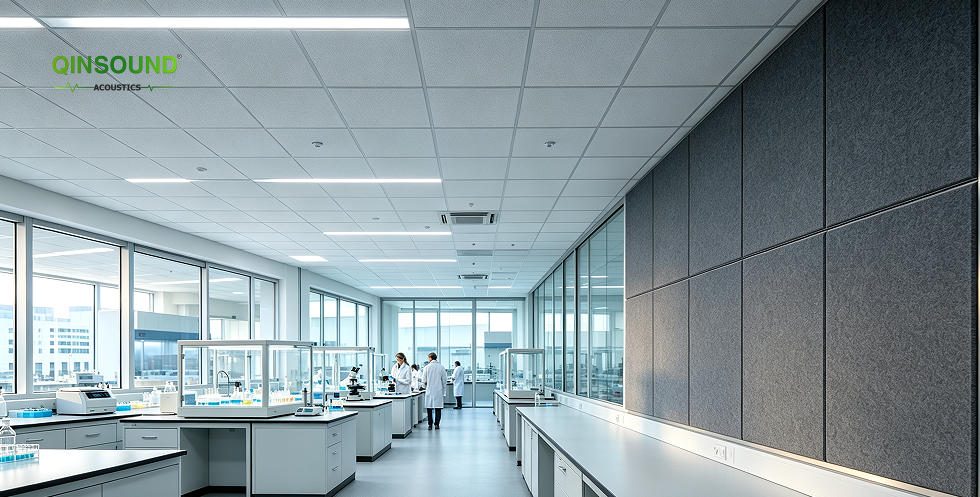
Across North American and European life science sectors, laboratory acoustic performance is evolving from a secondary comfort factor to a core indicator affecting experimental accuracy and staff occupational health. Industry research shows that sustained high background noise in cleanrooms and testing labs can disrupt precision instrument readings, increase experimental error rates, and contribute to long-term hearing fatigue and stress among researchers.
In response, professional acoustic systems are being widely specified in new and renovated life science facilities. High-density inorganic fiberglass acoustic ceilings have become the mainstream solution for laboratory public areas and cleanroom perimeters, delivering inherent Class A fire resistance and NRC 0.90–0.95 high-efficiency sound absorption to reduce equipment and ventilation noise. Recycled polyester acoustic panels are applied to office and analysis zone walls, with zero-formaldehyde, low-VOC formulations that meet strict indoor air quality requirements for controlled laboratory environments. All materials support cleanability and compatibility with laboratory hygiene protocols.
Market monitoring data shows that acoustic material procurement for life science construction projects grew by 30% year-on-year in the first half of 2026. As research institutions and biopharmaceutical enterprises continue to upgrade laboratory construction standards, high-performance acoustic systems will become a standard component of modern lab design, supporting both research reliability and long-term staff wellbeing.