


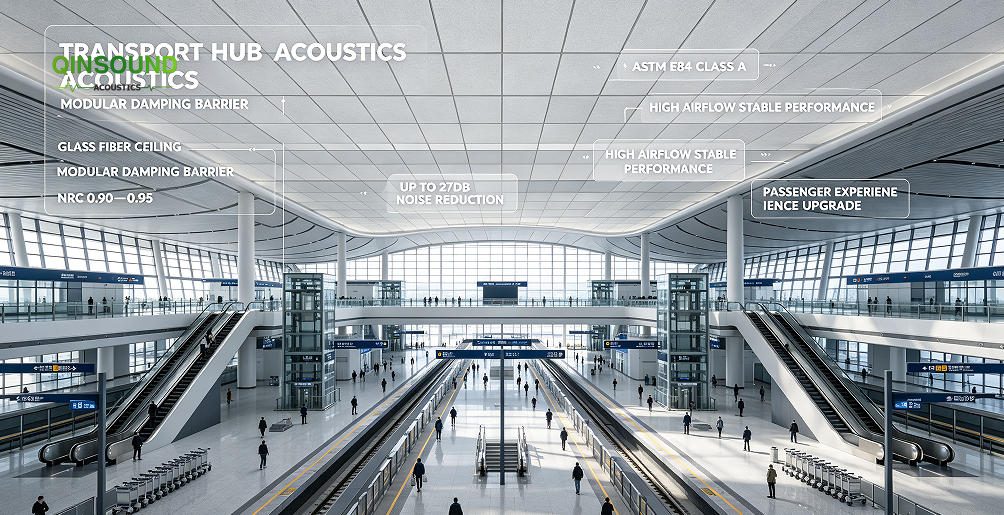
Major cities across Asia, the Middle East and Europe are investing heavily in transportation infrastructure expansion, including new airport terminals, metro stations, high-speed rail hubs and intercity bus terminals. These high-volume public spaces face persistent composite noise from passenger flow, luggage trolleys, PA systems, HVAC and train/aircraft operation. As passenger experience standards rise, transit authorities are tightening noise level requirements in terminal halls, waiting areas and passenger circulation zones, driving demand for comprehensive acoustic treatment solutions.
Industry data shows that the scale of acoustic renovation and new-build acoustic specification in transportation hubs increased by 36% year-on-year in the first half of the year. The dominant engineering solution combines high-density inorganic fiberglass acoustic ceiling tiles with modular damping sound barriers. Fiberglass ceiling tiles, with an NRC rating of 0.90–0.95 and inherent ASTM E84 Class A fire resistance, are installed across main concourse and waiting area ceilings to absorb broad-spectrum reflected noise in large open spaces. The material offers excellent sag resistance, mould resistance and dimensional stability under high-airflow, fluctuating temperature conditions, with minimal long-term maintenance — critical for 24/7 transportation facilities. Modular sound barriers, with a multi-layer damping structure delivering up to 27dB single-layer STC rating, are installed along escalator zones, equipment room passages and platform edges to block direct equipment and transit noise from spreading to passenger waiting areas.
All products carry complete fire safety and acoustic performance test reports to support municipal infrastructure acceptance and compliance review. Industry analysts predict that as global urbanization drives continued transportation investment over the next decade, acoustic treatment will become a standard component of transit hub design specifications, and suppliers with large-scale project delivery capability and full product certification will dominate this high-growth segment.