


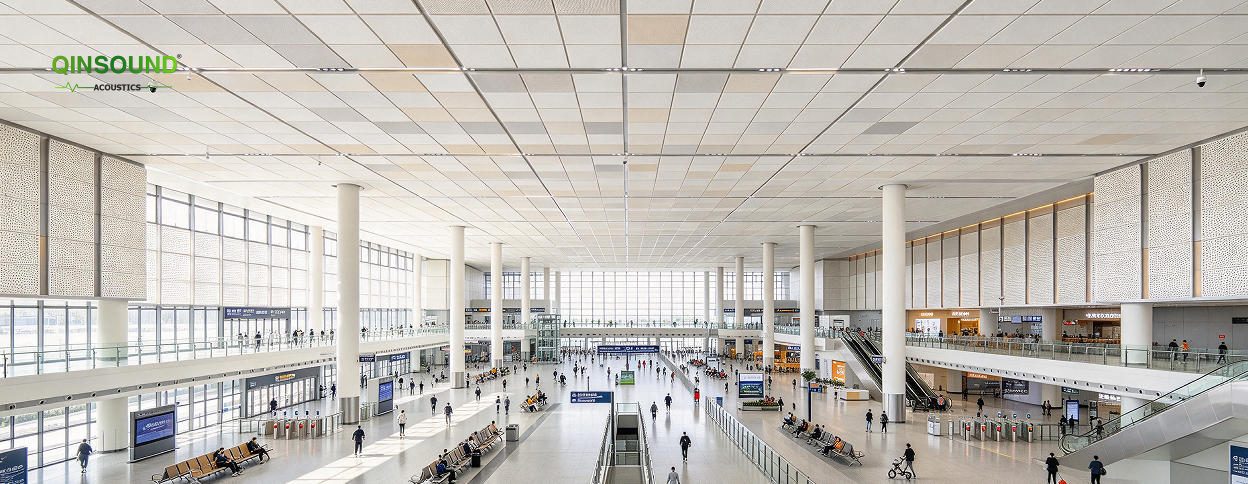
Driven by the new round of urban rail transit and airport hub construction upsurge around the world, the acoustic environment of large passenger flow public spaces such as waiting halls and transfer stations has received increasing attention. High ceilings, hard ground and a large number of reflective surfaces lead to long reverberation time and poor broadcast clarity in transportation hubs, which affects passenger experience and operational efficiency. Acoustic design is gradually being included in the standard design specifications of transportation buildings.
Industry monitoring data shows that in the first half of 2026, acoustic projects in public areas of transportation hubs worldwide increased by 25% year-on-year. The mainstream solution adopts full-ceiling high-density inorganic fiberglass acoustic ceiling tiles, with an NRC rating of 0.90–0.95, which efficiently controls overall ambient reverberation in large spaces, and has excellent sag resistance and aging resistance, adapting to long-term operation of high-flow public places. Partial perforated acoustic panels with mineral wool backing are arranged on the walls to optimize mid-low frequency resonance and further improve the clarity of public broadcasts.
QinSound’s transportation building acoustic solutions are suitable for various scenarios such as airport terminals, railway stations and subway transfer stations. All products carry ASTM E84 / EN 13501 Class A fire certification, meeting the safety requirements of large public gathering places. Industry analysts predict that with the continuous investment in transportation infrastructure, acoustic systems will become a standard configuration for the construction of transportation hubs.