

Major universities and national libraries across East Asia and Europe are upgrading special ancient book and manuscript conservation facilities to modern heritage preservation standards. Beyond temperature and humidity control, institutions are increasingly recognising that a controlled, low-particle acoustic environment is essential both for researcher focus and for long-term preservation of fragile paper and parchment materials.
Ancient book conservation reading rooms have extremely stringent acoustic material requirements. Background noise must be kept very low to support deep scholarly research. Most critically, acoustic materials must be zero-shedding and ultra-low-particle to avoid depositing dust and micro-fibres on rare manuscripts and scrolls. All installations must also be minimally invasive to preserve historic building fabric, and must meet the highest fire safety and indoor air quality standards for archival spaces.
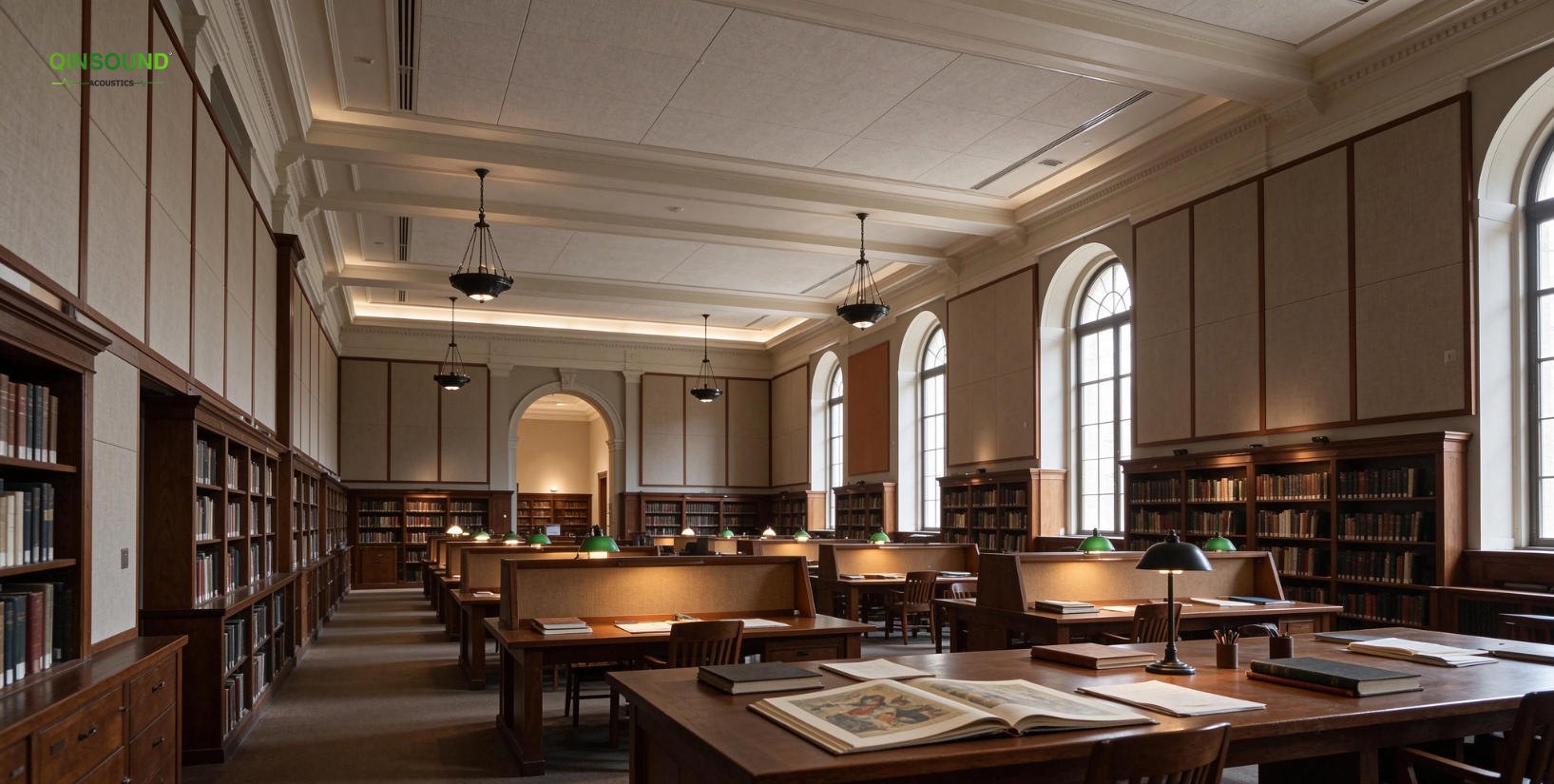
QinSound delivers precision conservation-grade acoustic systems for ancient book and special collections facilities. Reading room ceilings are fitted with high-density fiberglass acoustic ceiling tiles with fully hardened sealed surfaces, providing efficient broadband absorption with zero fibre shedding — eliminating particulate contamination risk to rare materials. Wall study carrels and side wall zones use fabric wrapped acoustic panels mounted on concealed free-standing frames, with no penetration of historic structural walls. All products meet Class A fire safety and ultra-low emission standards, with finishes matched to traditional library interiors.
Cultural heritage specialists observe that as preservation standards advance, ultra-low-particle acoustic design will become a standard component of special collections and ancient book library upgrades, alongside temperature, humidity and light control.