


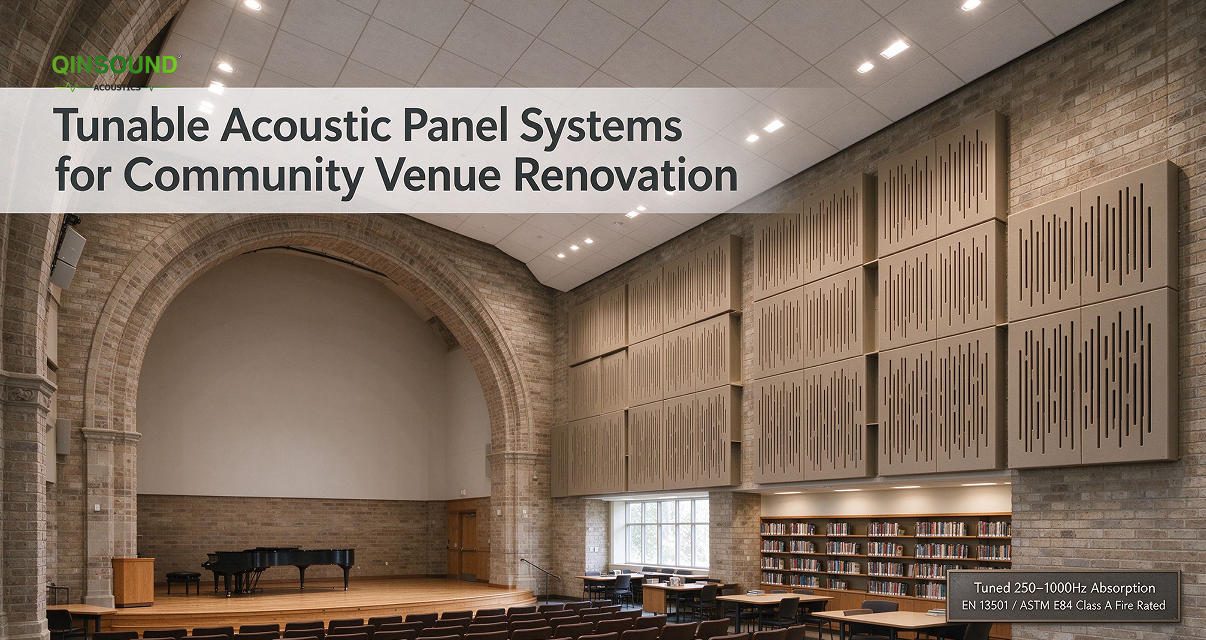
A wave of public facility renewal is underway across Europe and North America, with community halls, town auditoriums, library event spaces and small performing arts venues undergoing comprehensive interior upgrades. Many of these venues were originally built with hard masonry walls and high vaulted ceilings, resulting in excessive mid-low frequency reverberation, uneven sound distribution and poor speech intelligibility. As venues host a growing mix of lectures, film screenings, performances and community events, one-size-fits-all acoustic finishes no longer deliver acceptable results.
Architects and acousticians increasingly opt for tunable resonant absorption systems rather than simple flat absorption panels. Grooved and perforated acoustic panels, paired with mineral wool infill and calibrated rear cavity depths, can be tuned via acoustic simulation to target specific frequency bands, balancing speech clarity and musical warmth for multi-use spaces. This approach preserves architectural character while delivering measurable acoustic improvement.
QinSound’s grooved and perforated resonant panel systems are engineered for mixed-use public venues. Perforation ratios, slot dimensions and cavity depths are calibrated to each venue’s volume and geometry, targeting 250–1000 Hz standing wave issues common in masonry halls. When combined with fiberglass acoustic ceiling systems to control overhead reflections, the solution delivers balanced full-band absorption and uniform sound coverage across all seating positions. All products carry EN 13501 / ASTM E84 Class A fire certification, meeting public assembly building safety requirements.
Industry data indicates that acoustic renovation projects for community cultural venues increased by roughly 29% year-on-year in the first three quarters of 2026, with tunable panel systems taking the largest share of new specifications.