

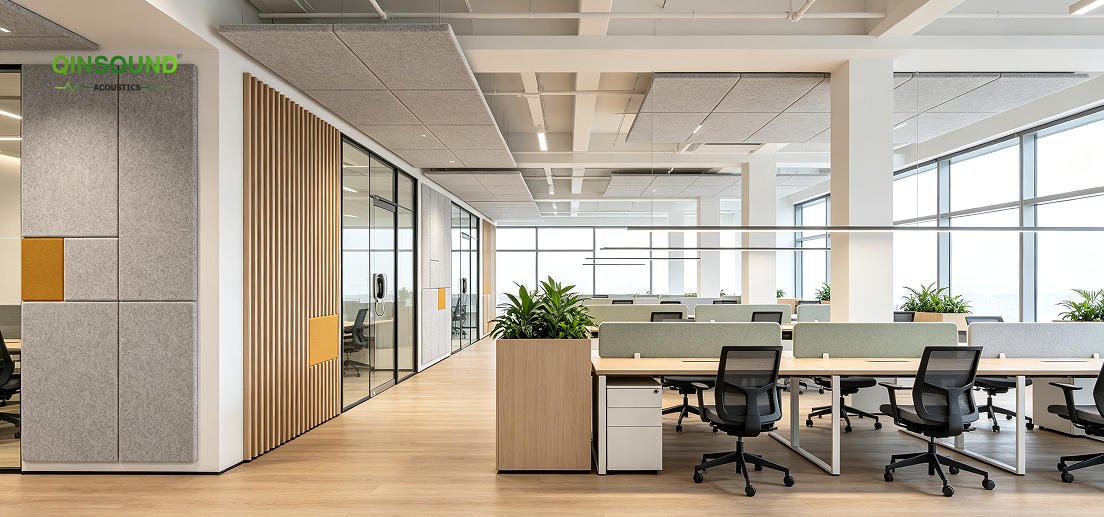
Driven by the hybrid office trend, the flexible co-working and serviced office sector continues to expand in scale. As tenant groups shift from individual freelancers to enterprise team clients, the requirements for acoustic environment are also evolving from simple decorative aesthetics to dual standards of acoustic privacy and environmental compliance. More and more operators take acoustic performance and green material certification as core indicators when upgrading their spaces.
At present, 100% recycled polyester fiber acoustic panels have become the most widely used product line in flexible office space renovation. The material has an NRC of 0.85–0.95, which can effectively reduce cross-station voice crosstalk in open office areas and improve the confidentiality of discussions in phone booths and meeting rooms. The formaldehyde-free and ultra-low VOC formula helps projects apply for green building certifications such as LEED and WELL. At the same time, the panels support custom color matching and special-shaped cutting, which can be highly integrated with various interior design styles. Adhesive non-destructive installation can be carried out in stages at night, which is suitable for the renovation needs of operating projects.
Industry data shows that the procurement volume of acoustic materials for flexible office spaces increased by 28% year-on-year in the first half of the year. Analysts pointed out that as enterprise clients pay more attention to employee health and office experience, acoustic and environmental protection indicators will further penetrate into the site selection and evaluation system of flexible offices. Suppliers with complete product certification systems and custom processing capabilities will gain a more obvious competitive advantage.