


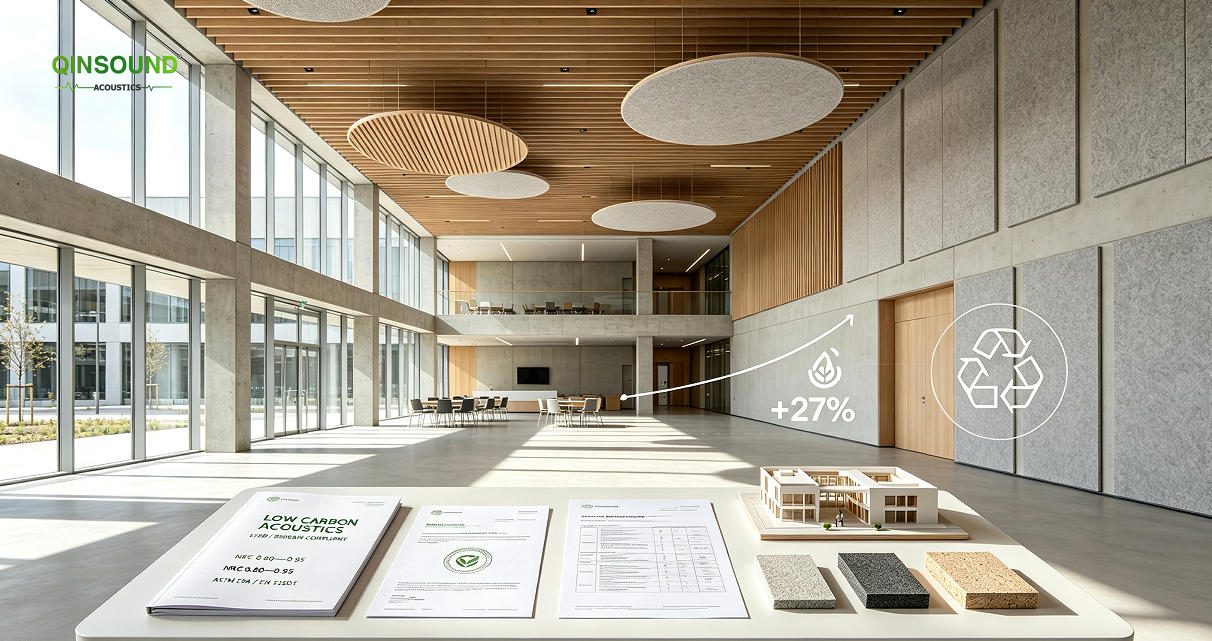
Against the backdrop of tightening carbon emission regulations for commercial buildings across North America and Europe, acoustic material selection is no longer limited to sound absorption performance and fire safety, but has increasingly incorporated full-lifecycle carbon footprint as a core evaluation indicator. More and more green building certification systems have raised the weight of recycled and low-embodied-carbon building materials, pushing acoustic material suppliers to upgrade their product systems and production processes.
Industry monitoring data shows that low-carbon acoustic product lines represented by 100% post-consumer recycled polyester fiber panels and low-embodied-carbon cement-bonded wood wool panels have seen a year-on-year increase of more than 27% in designated usage in new commercial construction projects in the first half of the year. Such materials deliver stable NRC 0.80–0.95 sound absorption performance while significantly reducing carbon emissions in production, transportation and end-of-life recycling stages, effectively helping projects meet embodied carbon accounting targets and contribute points to green building certification systems such as LEED and BREEAM. All mainstream products have passed ASTM E84 / EN 13501 Class A fire rating tests, fully complying with public and commercial building safety codes.
Analysts point out that as carbon compliance requirements continue to penetrate into subdivisions such as offices, education and healthcare, acoustic material suppliers with complete carbon footprint verification documents, low-carbon production systems and recyclable product matrices will gain clearer competitive advantages. Policy-driven product upgrading is expected to continue driving structural growth in the sustainable acoustic materials track in the next three to five years.