

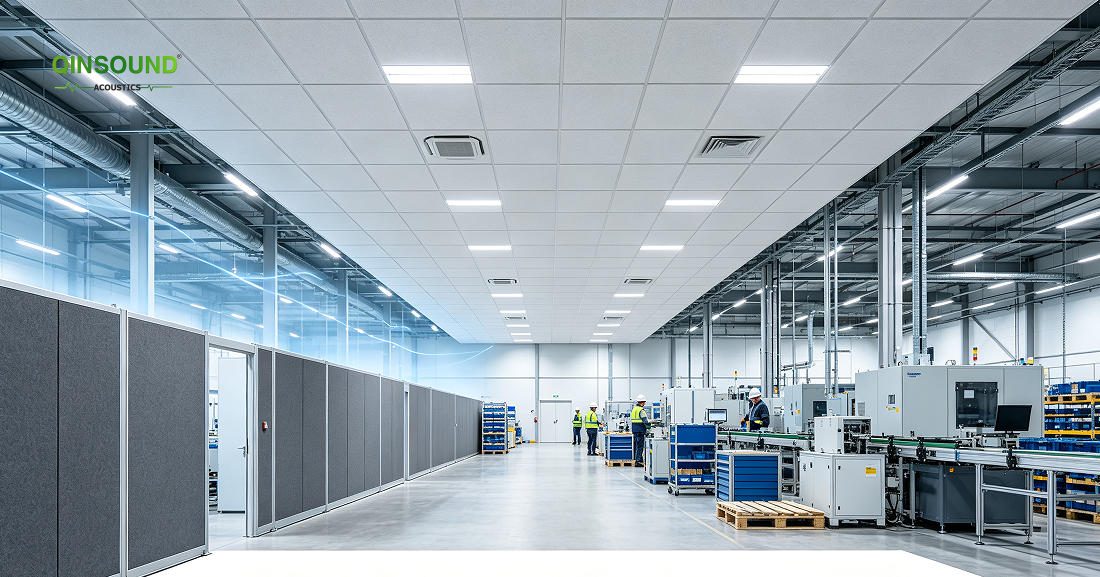
Both EU OSHA and the U.S. Occupational Safety and Health Administration have updated workplace noise exposure limit standards in 2026, lowering the acceptable long-term noise exposure threshold for workers in manufacturing, logistics, data centers and other industrial scenarios. The regulatory tightening has prompted industrial facility operators to accelerate acoustic environment upgrades, driving rapid growth in demand for industrial-grade acoustic building materials.
Heavy-duty fiberglass acoustic ceilings and impact-resistant polyester acoustic wall panels have become the core products for industrial acoustic retrofitting. Fiberglass ceilings, with inherent Class A fire resistance, corrosion resistance and NRC 0.90–0.95 high-efficiency sound absorption, are suitable for long-term operation in high-temperature, high-humidity and dusty industrial environments. Impact-resistant polyester panels are used in workshop walls and operation areas to reduce equipment noise propagation and improve on-site communication clarity. All products meet the durability and safety requirements of industrial scenarios.
Relevant data shows that the scale of industrial acoustic renovation projects in Western markets increased by 31% year-on-year in the first half of the year. Industry analysts believe that with the continuous improvement of occupational health and safety systems, acoustic upgrading will gradually shift from optional employee welfare investment to mandatory compliance investment, bringing sustained growth momentum to the industrial acoustic building materials track.