

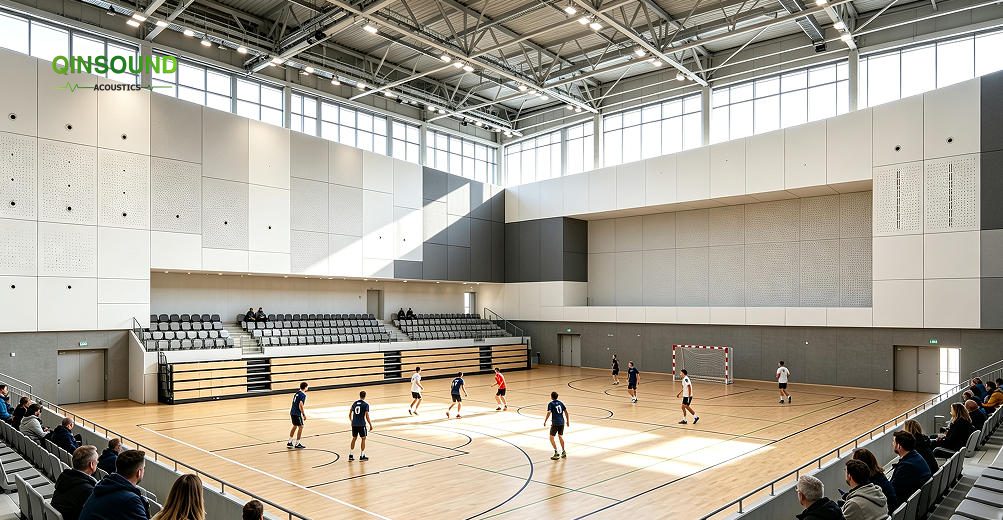
Indoor sports and recreation facility construction is booming globally, and low-frequency reverberation remains one of the most persistent acoustic challenges for gymnasiums, indoor courts and multipurpose sports halls. Conventional porous acoustic materials struggle to address the 250Hz–1000Hz mid-low frequency noise that dominates large enclosed sports spaces.
Grooved and perforated resonant acoustic panels, engineered on the Helmholtz resonance principle, have become the industry standard specification for new and renovated sports venues. The precision slot-and-hole structure targets stubborn low-frequency standing waves, and when paired with rear air cavities and acoustic fill, achieves an overall NRC of up to 0.90. Durable wood-veneer surfaces also withstand impact and wear from high-intensity athletic use.
Facility design data shows that over 65% of newly built indoor sports facilities now specify resonant acoustic systems. Proper acoustic design not only improves speech intelligibility for coaching and announcements but also reduces athlete auditory fatigue and extends comfortable usage time for occupants.