

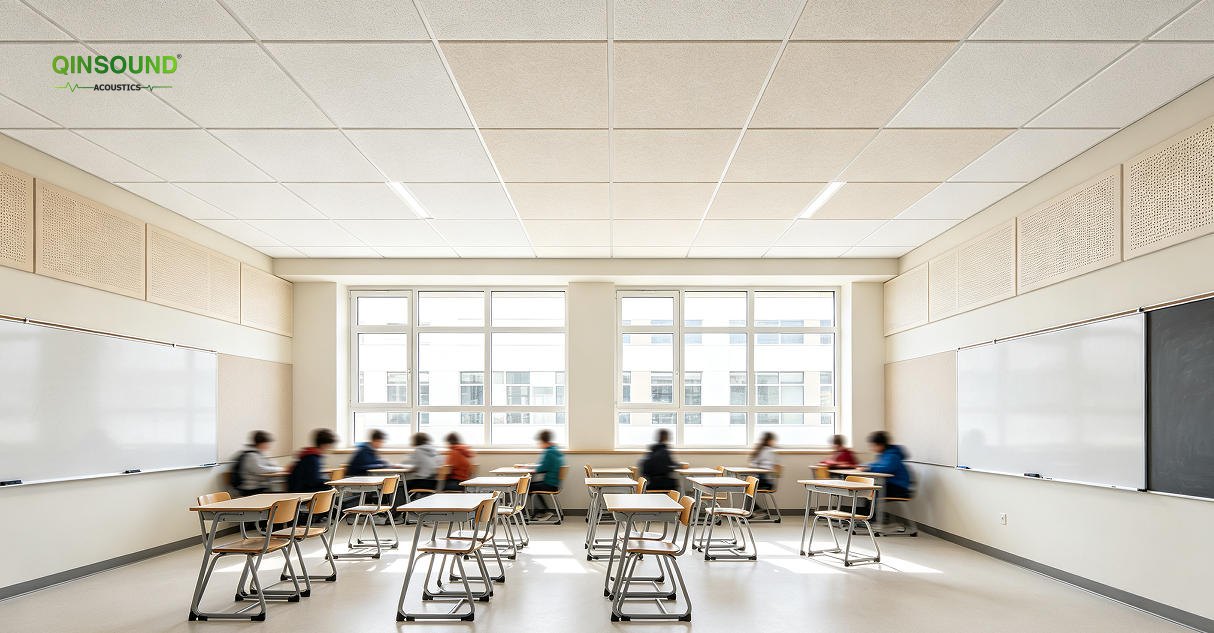
Authorities in many European and North American regions have successively updated acoustic design standards for educational facilities, making clear requirements for reverberation time and background noise in classrooms, auditoriums and campus public areas. Driven by policies, the acoustic renovation of existing campuses and the acoustic standard configuration of new campuses have become important construction directions for the education sector, driving the demand for professional acoustic materials to continue to grow.
At present, high-density inorganic fiberglass acoustic ceilings are the first choice for classroom and corridor acoustic renovation. The material has an NRC of 0.90–0.95, which can effectively reduce the superposition of classroom speech noise and environmental noise, and help improve students' attention and teachers' speech clarity. The product has inherent Class A fire resistance, excellent sag resistance and mildew resistance, and has low long-term maintenance cost, which is very suitable for high-frequency use scenarios of campus facilities. For auditoriums and multi-function halls, grooved perforated resonant acoustic panels are mostly used to solve mid-low frequency standing wave problems and achieve full-band balanced sound absorption.
Industry statistics show that the procurement scale of acoustic materials for educational facilities increased by 30% year-on-year in the first half of the year. Industry analysts believe that with the deepening of the concept of healthy campus construction, acoustic environment, as an important factor affecting learning efficiency and physical and mental health, will receive more attention. The campus acoustic renovation market will maintain steady growth in the next three to five years.