

Across Europe, North America and major Asia-Pacific cities, urban regeneration and existing building retrofit have become core drivers of construction activity. Aging office buildings, former industrial warehouses converted to mixed-use spaces, and mid-century public facilities all face common acoustic deficits: hard original surfaces, outdated partition systems and insufficient ceiling absorption. As retrofit projects pursue higher occupant comfort, energy efficiency and modern functional standards, acoustic upgrading has moved from an optional enhancement to a standard scope item in renovation specifications.
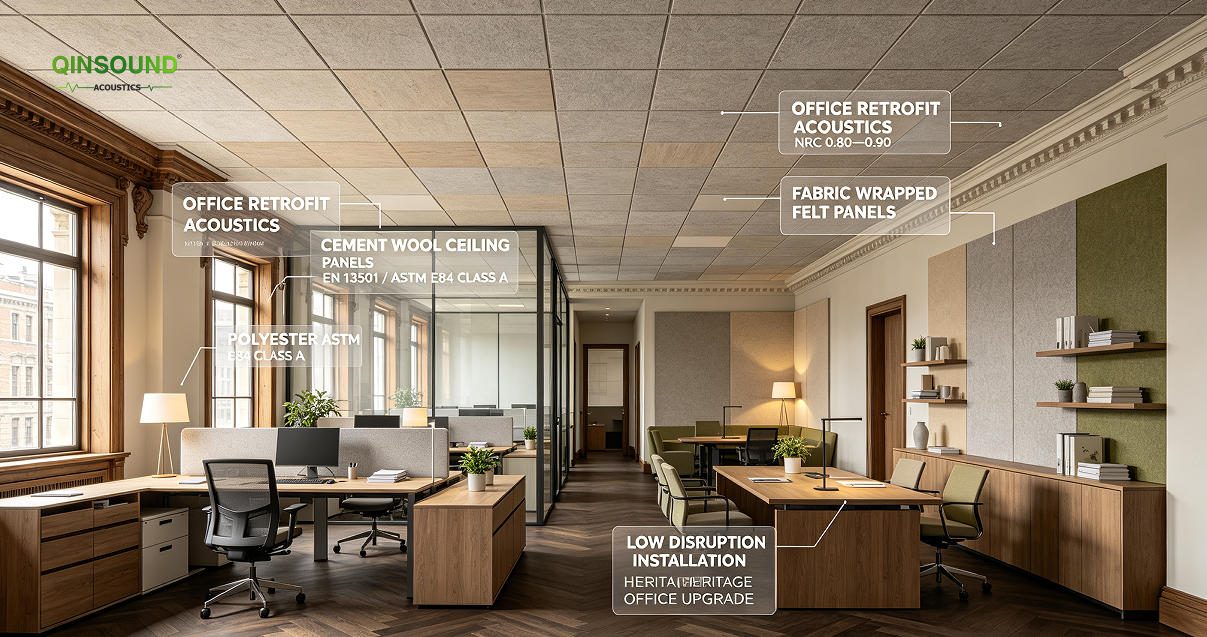
Market feedback shows that acoustic-related expenditure in building retrofit projects increased by 31% year-on-year in the first half of the year. Cement-bonded wood wool acoustic ceiling panels are widely used in converted industrial and warehouse spaces, delivering an NRC rating of 0.80–0.90 while preserving the raw, textured aesthetic of original structures. The material meets EN 13501 / ASTM E84 Class A fire standards and offers good moisture stability, suitable for semi-open and enclosed retrofit environments. For office and public area retrofits, fabric wrapped acoustic panels with high-density fiberglass core (NRC 0.85–1.0) are installed on partition walls and feature surfaces, reducing inter-room sound transmission and eliminating flutter echo. Polyester fiber acoustic panels (NRC 0.85–0.95) are preferred for fast-track, low-disruption retrofits thanks to their lightweight, adhesive-mountable installation and E0 grade formaldehyde-free composition.
Industry observers note that urban regeneration policies will continue to expand the stock of buildings eligible for retrofit over the next decade. Acoustic suppliers that can provide non-destructive installation solutions, phased construction support and material compatibility with heritage or existing structures will capture a growing share of the retrofit market.