

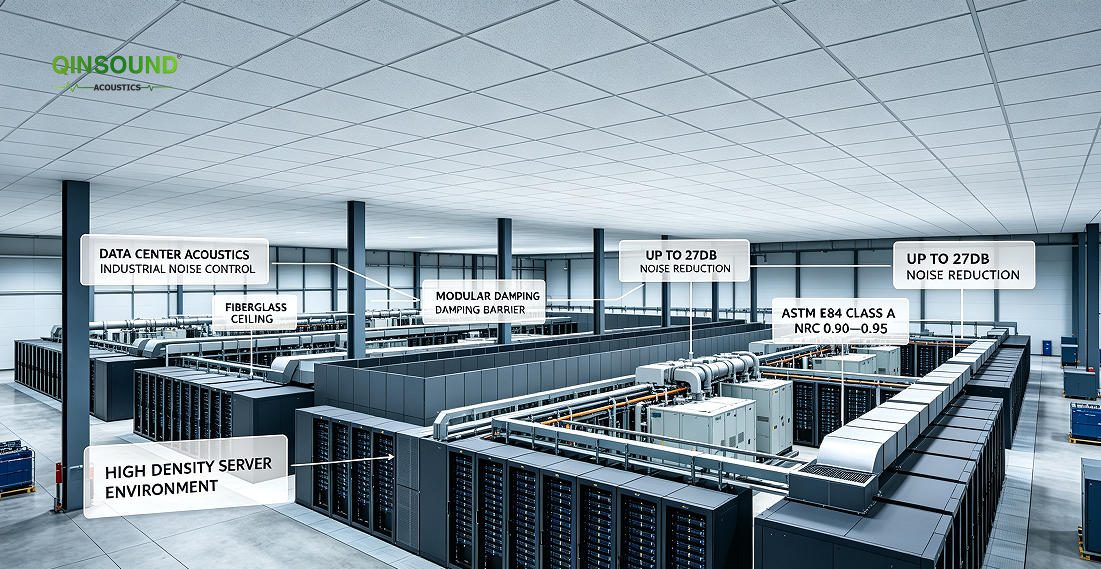
Driven by the rapid growth of cloud computing, artificial intelligence training and edge computing infrastructure, global data center construction has maintained a high growth rate. Large-scale data centers and colocation facilities integrate dense server racks, high-power cooling systems and continuous HVAC operation, generating persistent broadband noise across equipment halls and administrative zones. Long-term exposure to high noise levels affects on-site maintenance staff, and noise transmission to adjacent office and control rooms also undermines operational efficiency. Facility owners and EPC contractors are increasingly incorporating acoustic design into the initial engineering phase, rather than treating it as a post-completion remedial measure.
Industry data shows that the specified usage of industrial acoustic products in data center projects increased by 33% year-on-year in the first half of the year. The mainstream solution combines high-density inorganic fiberglass acoustic ceiling tiles with modular damping sound barriers. Fiberglass ceiling tiles deliver an NRC rating of 0.90–0.95 with inherent ASTM E84 Class A fire resistance, absorbing reflected ambient noise from equipment and airflow across large open server halls. The material offers excellent sag resistance, dimensional stability and low maintenance requirements, suitable for long-term operation in controlled-temperature, high-airflow environments. Modular sound barriers with a multi-layer damping structure achieve up to 27dB single-layer STC rating, installed around high-noise cooling units and transformer zones to block direct noise propagation to staff work areas.
Industry analysts point out that as AI computing clusters raise server power density and cooling system noise levels, acoustic performance will become an increasingly important evaluation indicator in data center facility design. Acoustic suppliers with complete industrial product lines, fire safety certification and EPC project delivery capabilities will gain clearer competitive advantages in this fast-growing segment.