


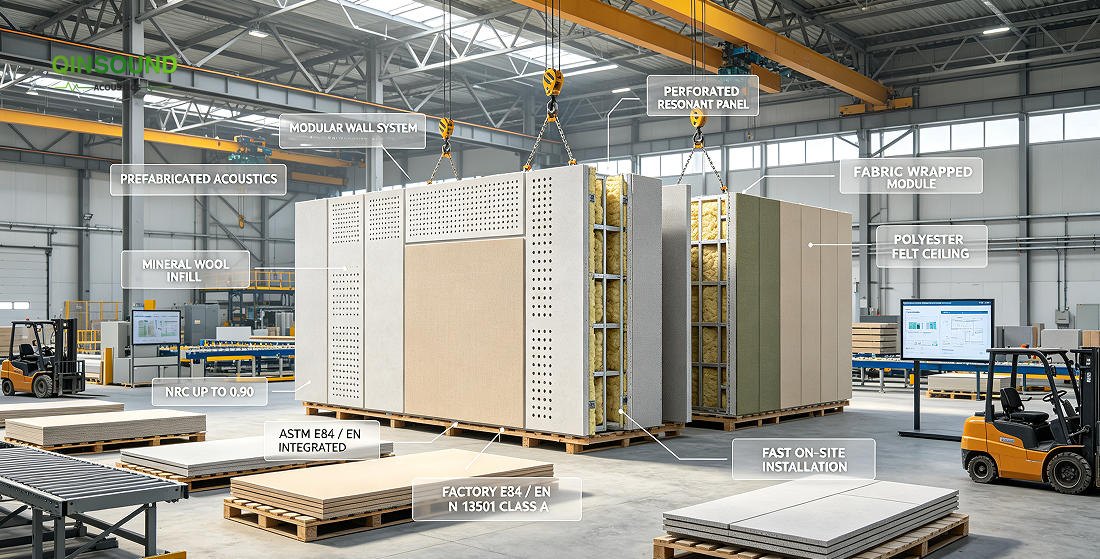
Prefabricated and modular construction methods continue to gain market share globally, driven by labor shortages, tighter project schedules and demands for higher construction quality consistency. In prefabricated building systems, wall panels, ceiling modules and partition components are manufactured off-site and assembled on location, which requires acoustic materials to be integrated into modular components at the factory stage rather than applied as separate on-site finishes. This shift is accelerating the adoption of factory-integrated modular acoustic systems.
Industry data shows that the procurement volume of modular acoustic products for prefabricated construction increased by 28% year-on-year in the first half of the year. Grooved and perforated resonant acoustic panels, with mineral wool infill and rear air cavity structures, are increasingly supplied as pre-assembled wall modules. The system achieves an overall NRC rating of 0.90 with balanced full-band absorption, and the panel dimensions can be standardized to match common prefabricated wall module sizes, enabling direct factory integration and rapid on-site installation. Polyester fiber acoustic panels, with their lightweight and CNC-cuttable properties, are widely used in prefabricated ceiling and partition modules, delivering NRC 0.85–0.95 with E0 grade formaldehyde-free composition. Fabric wrapped acoustic panels are also available as pre-upholstered modular units, reducing on-site finishing labor and ensuring consistent quality across large-scale projects.
All modular acoustic product lines carry ASTM E84 / EN 13501 Class A fire certification, meeting the safety requirements for prefabricated commercial and residential buildings. Industry analysts predict that as prefabricated construction penetration exceeds 25% in major markets by 2028, factory-integrated acoustic systems will become the dominant supply model, and acoustic suppliers with modular product design capability and factory-level production integration will be best positioned to capture this structural demand.