

Project Overview
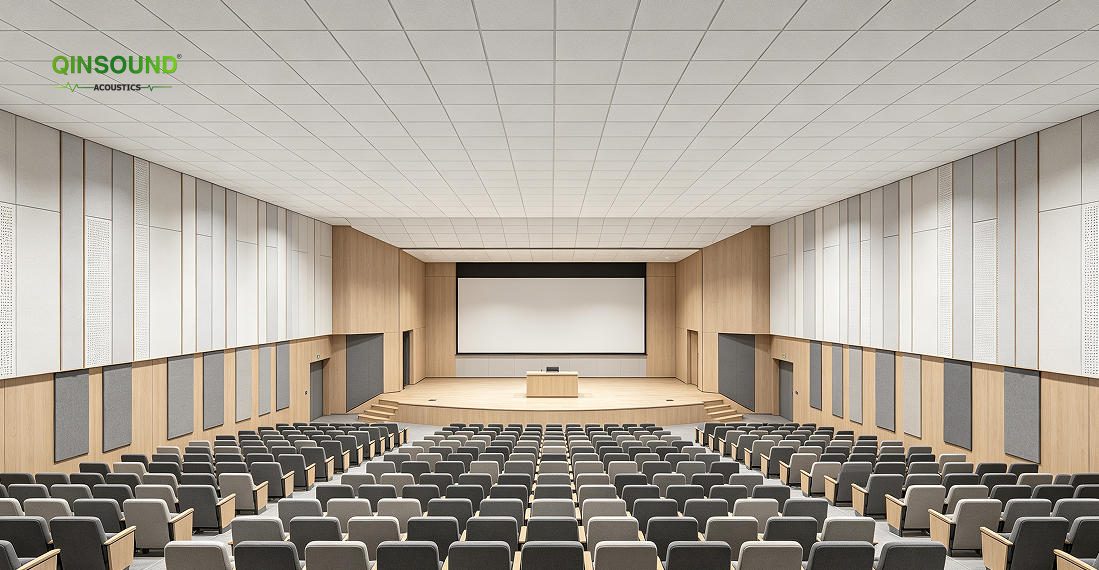
Acoustic upgrade for a 750-seat multi-functional academic auditorium at a higher education institution, hosting academic lectures, conference reports, small theatrical performances and campus cultural activities. The original masonry structure with high ceiling causes prominent mid-low frequency standing waves and uneven sound field distribution. Speech intelligibility during lectures is poor, and musical performances lack layering and dynamic range. The institution requires the acoustic scheme to support both speech and performance scenarios, meet Class A fire protection standards for educational buildings, and be durable and wear-resistant for high-frequency campus use.
Solution Deployment
The solution adopts a three-layer professional acoustic tuning system:
- Side walls & rear walls: Installed with a grooved and perforated resonant acoustic panel system, paired with mineral wool infill and rear air cavity structure. Based on acoustic simulation calculations of the hall’s volume and geometry, the slot and perforation ratio is precisely adjusted to target the 250–1000Hz mid-low frequency standing wave issue. The overall system NRC reaches 0.90, achieving balanced full-band sound absorption and meeting dual acoustic standards for both speech and live music.
- Ceiling area: Fitted with high-density fiberglass acoustic ceiling tiles, NRC 0.90–0.95, controlling overhead reflected sound and optimizing overall sound field uniformity.
- Audience area rear wall: Added fabric wrapped acoustic panels to optimize late reflection effects and improve the auditory experience for rear audience members.
All panels have passed EN 13501 Class A fire certification, with impact-resistant surfaces suitable for public campus venues. The project is completed during a scheduled academic break, with a construction period of 24 days.
Project Outcome
Final acoustic testing shows that reverberation time falls within the optimal dual-use range for speech and live music. Speech intelligibility increases by more than 45%, and musical performances present clear layering and stable low-frequency response. The auditorium can flexibly host academic lectures, artistic performances and assembly activities without temporary acoustic supplementary equipment. The project passes the special acoustic assessment for educational buildings with excellent results.