

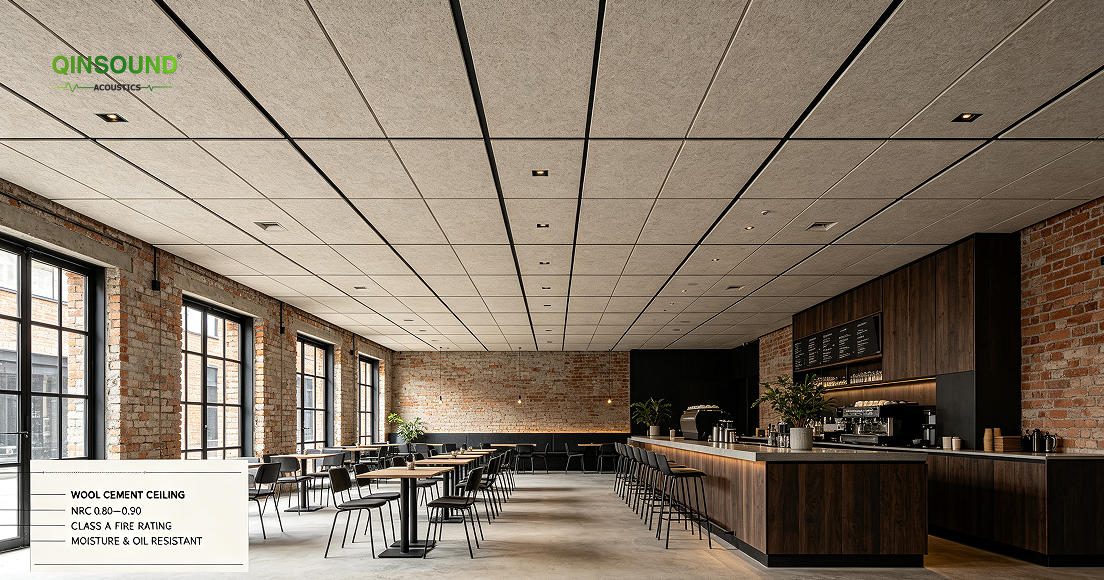
As the competition in the high-end catering and lifestyle industry intensifies, spatial experience has become a core factor differentiating brand positioning, and acoustic environment quality is receiving increasing attention from operators. A large number of industrial-style restaurants, boutique cafes and food halls have started to incorporate professional acoustic solutions into the initial design phase, rather than carrying out remedial renovation after opening.
Industry research shows that hard decorative materials such as exposed brick walls, concrete floors and high vaulted ceilings commonly used in high-end catering spaces often lead to severe reverberation. During peak dining hours, overlapping noise of conversations, tableware and background music will significantly reduce customer stay time and per capita consumption. The currently widely used cement-bonded wood wool acoustic ceiling solution, with NRC 0.80–0.90 efficient sound absorption, can effectively reduce overall ambient noise in the dining area. Its natural textured surface can be perfectly integrated with industrial, wabi-sabi and original style interior designs, and supports custom toning and irregular shape cutting. All products meet Class A fire protection and grease-resistant and moisture-proof standards, fully adapting to the long-term operation needs of catering environments.
Market observation shows that well-known chain catering brands have successively included acoustic design indicators in new store construction specifications. Industry insiders predict that acoustic performance will gradually shift from an optional value-added item to a standard configuration for high-end catering space design, bringing sustained growth momentum for scenario-based customized acoustic solutions.