

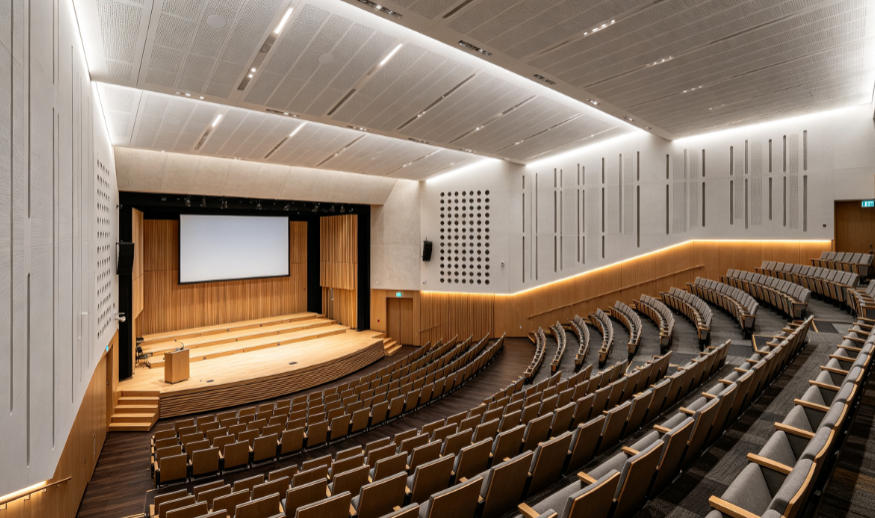
The global education infrastructure upgrading continues to advance in 2026, and acoustic environment has officially been included in the mandatory acceptance indicators of new and renovated school buildings in many countries. A number of educational studies have confirmed that classrooms with excessive reverberation will reduce students' speech recognition rate by more than 30%, directly affecting learning efficiency and academic performance, especially for younger students and children with hearing impairments.
For large educational spaces such as auditoriums, lecture halls and gymnasiums, grooved and perforated resonant acoustic panels have become the designated wall treatment solution. Based on the Helmholtz resonance principle, the panels accurately control the mid-low frequency noise of 250Hz–1000Hz through precise groove and hole structure design, which is exactly the frequency band that most affects speech clarity and is difficult for ordinary porous materials to handle. With the rear air cavity and mineral wool backing, the overall NRC reaches 0.90, realizing full-band balanced sound absorption.
At present, a large number of school renovation projects in Europe, the Middle East and Southeast Asia have listed resonant acoustic panels as the preferred material for large space acoustic transformation. Industry education facility designers said that with the formal implementation of mandatory acoustic standards, the school acoustic material market will usher in explosive growth, and professional grooved and perforated acoustic panels, as a targeted solution for large educational spaces, will be more widely used.