


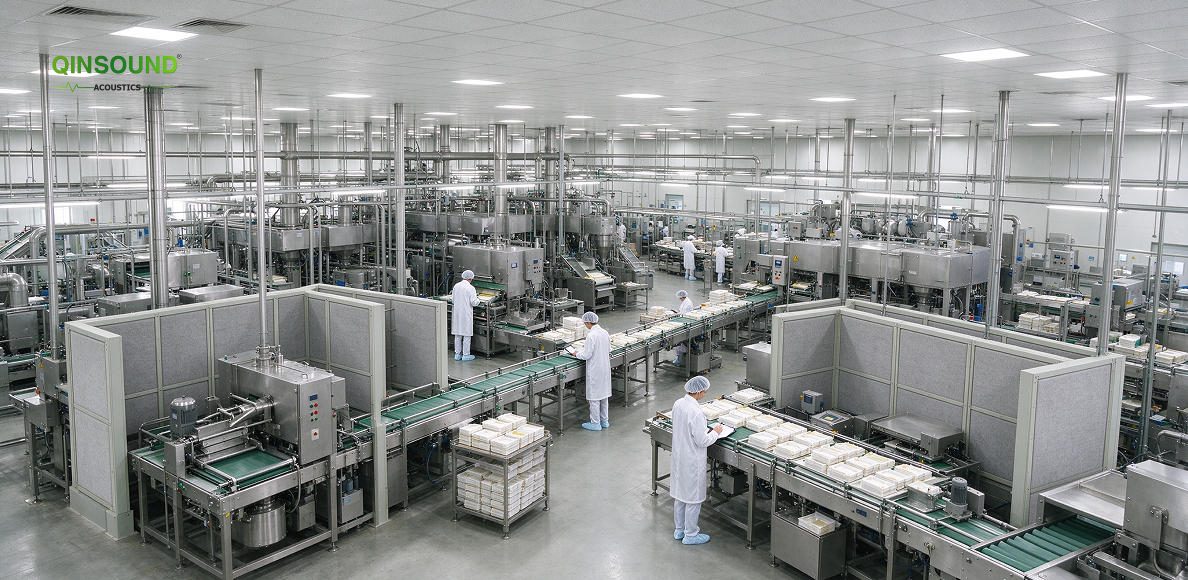
Driven by the continuous improvement of global food safety production specifications and occupational health standards, food processing factories are systematically upgrading their production environment management. Noise control, as an important part of workshop safety management, is receiving increasing attention. Production equipment, conveyor systems and ventilation facilities generate continuous broadband noise, which not only affects on-site operation efficiency, but also brings compliance risks of occupational noise exposure. The food production environment also puts forward high requirements on the hygiene, stain resistance and cleanability of acoustic materials.
Industry data shows that in the first half of 2026, the number of acoustic control projects in the global food processing industry increased by 30% year-on-year. The mainstream solution adopts high-density inorganic fiberglass acoustic ceiling tiles as the core, with an NRC rating of 0.90–0.95. The dense hardened surface is oil-resistant, dust-resistant and supports regular wiping and cleaning, which meets the hygiene requirements of food production environments and efficiently controls the overall ambient reverberation of the workshop. Modular damping industrial sound barriers are arranged around high-noise equipment, with a single-layer STC rating of up to 27dB, blocking direct noise propagation.
QinSound’s industrial acoustic product line is suitable for all types of food processing and production scenarios. All materials are non-particulate and fiber-shedding free, meeting food contact environment safety requirements, and all products hold ASTM E84 Class A fire certification. Industry analysts predict that with the continuous tightening of food production safety regulations, acoustic governance will become a standard part of factory safety management.