

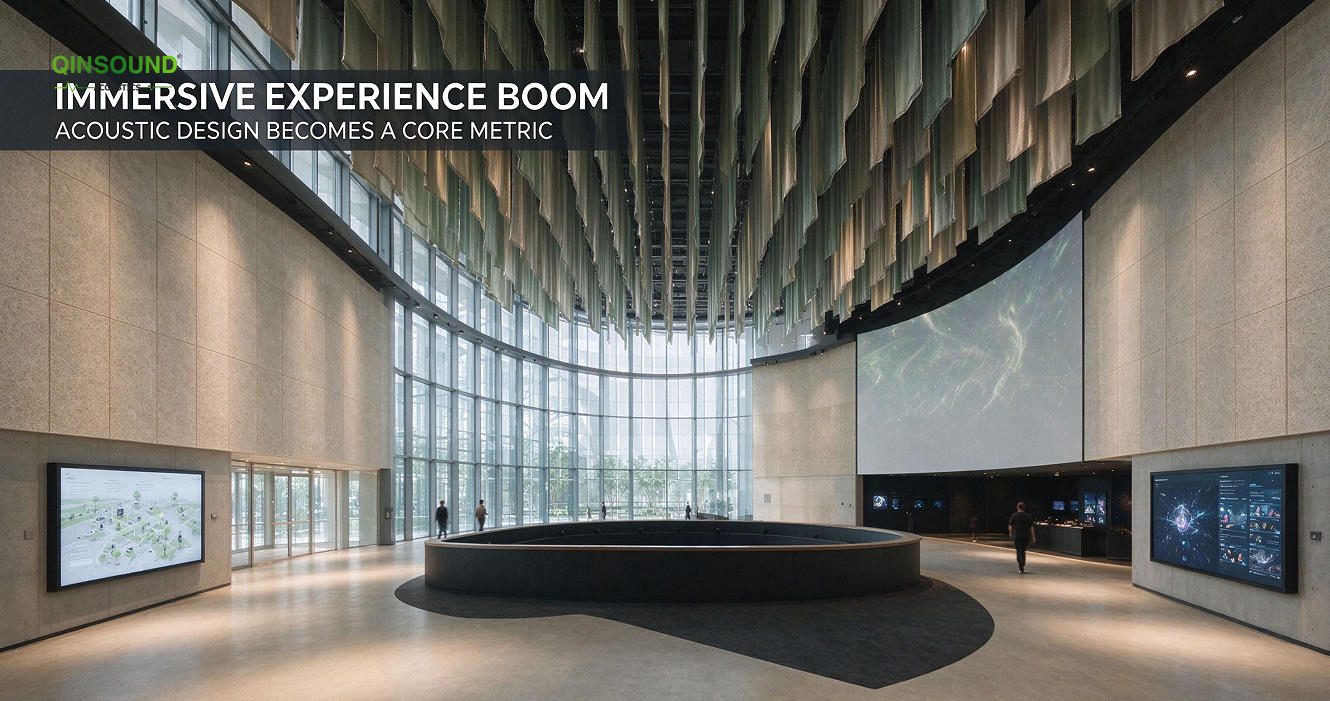
Driven by brand experiential marketing and digital art exhibition trends, the global immersive experience center market is projected to grow at an 8.3% CAGR through 2030. Brand flagship showrooms, digital art museums, technology discovery centers and visitor interpretation centers are being rolled out rapidly across North America, Europe and Southeast Asia. For these venues, acoustic quality has evolved from a supporting detail into a core component of the multi-sensory visitor journey.
Immersive spaces face unique acoustic challenges. Large open volumes, hard glass facades and projection surfaces create long reverberation that muddles directional audio and interactive soundtracks. Many venues invest heavily in spatial audio systems only to have performance degraded by untreated room acoustics. Solutions must also remain visually unobtrusive, so they do not compete with digital exhibits or break the immersive atmosphere.
QinSound supplies discreet, high-performance acoustic systems tailored for immersive and exhibition environments. Cement-bonded wood wool acoustic panels with fine matte finishes are used on feature walls and upper wall zones, delivering broadband mid-high frequency absorption while blending seamlessly with minimalist interior design. Suspended fabric acoustic baffles are arranged above visitor zones to control overhead reflections and shorten overall reverberation without obstructing sightlines or projection paths. All products are available in custom colours and sizes to match exhibition design concepts.
Experience design analysts note that as immersive venues become more sophisticated, integrated acoustic design will be specified at the earliest concept stage, rather than added as a post-construction correction.