

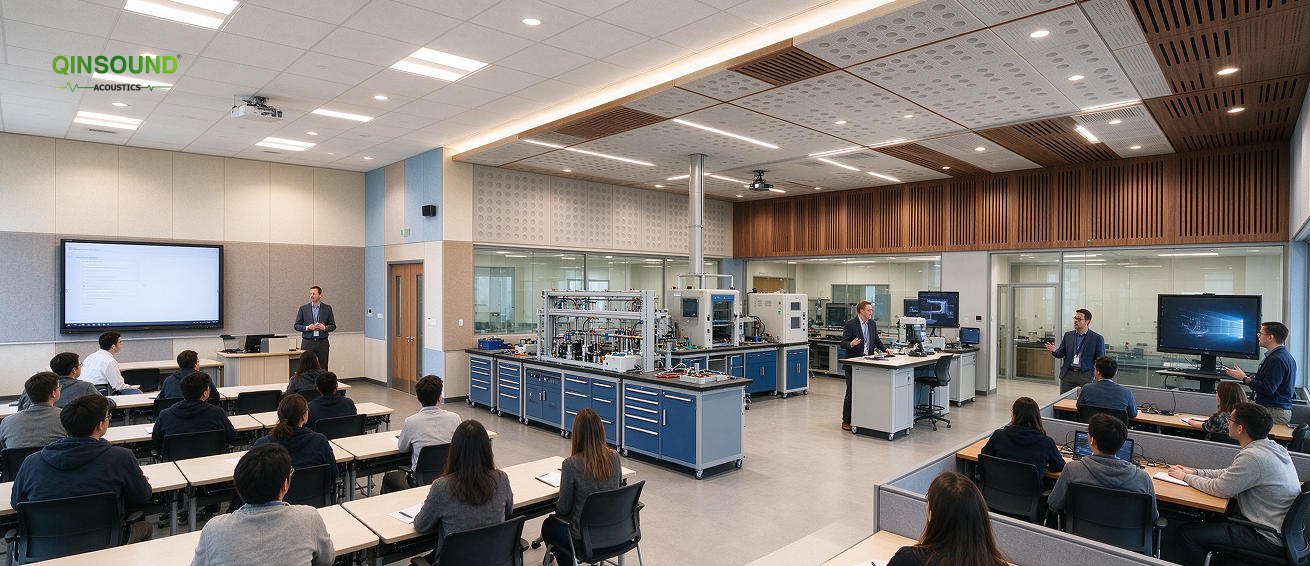
Driven by the continuous growth of global vocational education and skills training infrastructure investment, the construction and renovation projects of vocational colleges and training centers have increased significantly. The acoustic environment of classrooms and training venues directly affects teaching speech clarity, student attention and teaching effectiveness. Traditional classrooms generally suffer from excessive reverberation time and poor audibility in the back row, and equipment noise in vocational training scenarios further aggravates the acoustic environment challenges.
Industry monitoring data shows that in the first half of 2026, the number of acoustic projects in global vocational education venues increased by 29% year-on-year. Ordinary classrooms adopt E0-grade recycled polyester fiber acoustic panels (NRC 0.85–0.95), formaldehyde-free, ultra-low VOC, safe and environmentally friendly, effectively controlling classroom reverberation and improving teaching speech clarity. Multi-functional training halls adopt grooved and perforated resonant acoustic systems, with an overall NRC of 0.90, accurately controlling mid-low frequency standing waves, and balancing theoretical teaching and practical demonstration scenarios.
QinSound’s educational acoustic product line covers all scenarios of ordinary classrooms, multi-function halls and training venues. All products carry EN 13501 / ASTM E84 Class A fire certification, with impact-resistant surfaces, suitable for high-frequency use on campus. Industry research institutions predict that with the continuous upgrading of global vocational education infrastructure, acoustic design will become a standard part of educational building design.