

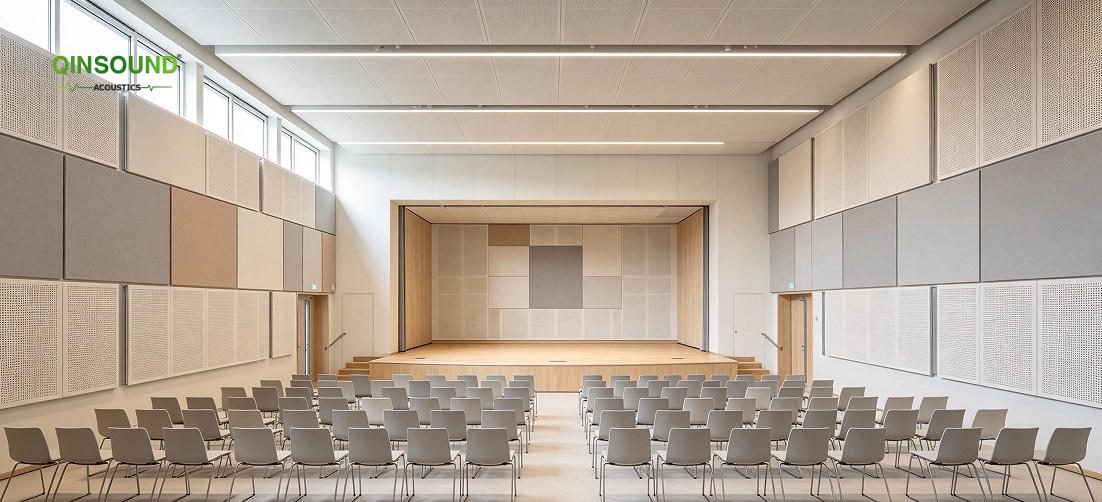
New versions of educational building acoustic standards have been fully implemented in many regions around the world in 2026. In addition to conventional mid-high frequency indicators, the control of low-frequency reverberation in large spaces such as auditoriums, gymnasiums and lecture halls has been officially included in the mandatory acceptance scope. Standards such as DIN 18041 and ANSI S12.60 have clearly put forward requirements for low-frequency reverberation time ratio, which puts forward higher requirements for the technical capability of acoustic materials.
Grooved and perforated resonant acoustic panels based on Helmholtz resonance principle have become the designated solution for educational space acoustic renovation. The precision slot and hole structure can accurately absorb the stubborn 250Hz–1000Hz mid-low frequency standing waves that are difficult to handle by ordinary porous materials. With the rear air cavity and mineral wool backing, the overall NRC reaches 0.90, realizing balanced full-band sound absorption and significantly improving speech intelligibility. The wood veneer appearance is solemn and elegant, with stable fire and impact resistance, which is suitable for long-term high-frequency use on campus.
Educational facility research data shows that after the acoustic renovation meets the standards, students' listening comprehension and classroom attention are significantly improved, and the teaching burden of teachers is also reduced. With the full implementation of mandatory acoustic standards for educational buildings, resonant acoustic technology will be more widely used in new campus construction and renovation projects.