

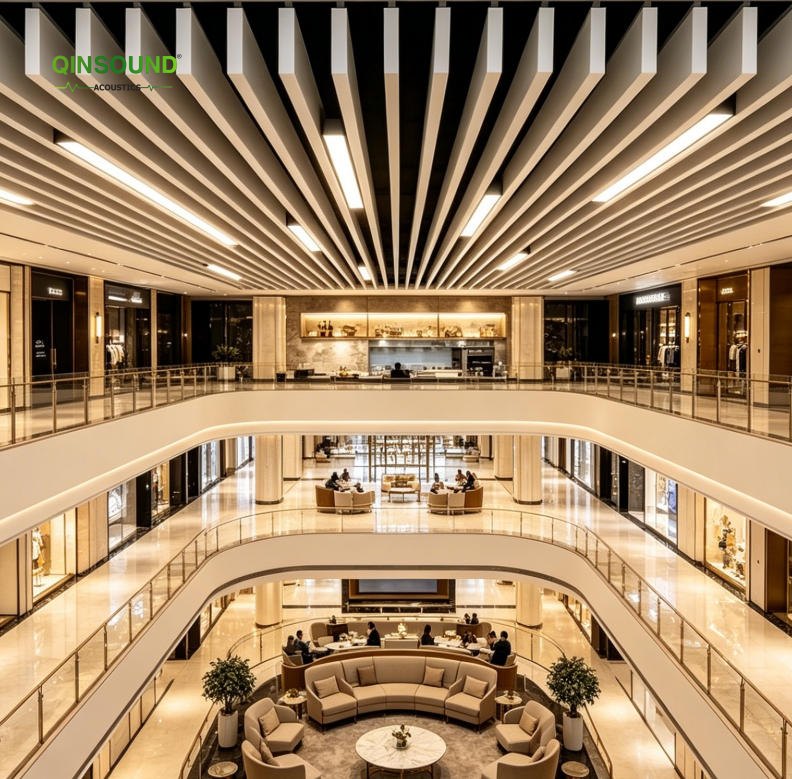
The wave of public infrastructure renovation continues to rise around the world, and ceiling material, as an important part of acoustic and fire safety upgrading, is accelerating the replacement of old and new. Traditional mineral wool and gypsum ceilings are gradually withdrawing from the large-scale public building market due to their defects such as limited sound absorption performance, easy moisture absorption, sagging deformation and high later maintenance costs.
High-density inorganic fiberglass acoustic ceiling tiles have become the mainstream replacement material for public buildings. The material has inherent Class A fire resistance, zero flame spread and low smoke toxicity, which fully meets the most stringent fire protection codes for public assembly buildings. The interconnected porous structure achieves NRC 0.90–0.95 ultra-high sound absorption efficiency, which can effectively deal with the complex mixed noise in lobbies, transportation hubs, exhibition halls and other places. At the same time, the product has excellent sag resistance, mildew resistance and dimensional stability, and can maintain stable performance under long-term air circulation and humidity fluctuation environments, greatly reducing the later operation and maintenance costs of the property.
Market statistics show that fiberglass acoustic ceilings have accounted for more than 62% of ceiling material selection in new public construction projects such as transportation hubs, municipal administration and exhibition centers in 2026. With the continuous improvement of public building quality requirements, high-performance fiberglass acoustic ceiling systems will further expand their market share.