

Project Background
This 4,700 ㎡ global biopharmaceutical regional headquarters houses open workspaces, confidential meeting suites, training rooms and staff welfare areas. The project was designed to achieve LEED Gold certification, with strict requirements for indoor environmental quality, material sustainability and occupant wellbeing. Internal workplace research for the project had linked poor office acoustics to reduced focus time and higher meeting fatigue among R&D and regulatory staff.
Core Acoustic Challenges
- Full-height glass partitions and exposed ceiling services created high speech crosstalk between work teams
- Confidential regulatory and clinical meeting rooms required guaranteed speech privacy from adjacent spaces
- All acoustic materials had to meet low-VOC, recycled content and E0 formaldehyde-free standards to contribute to green building credits
Solution & Implementation
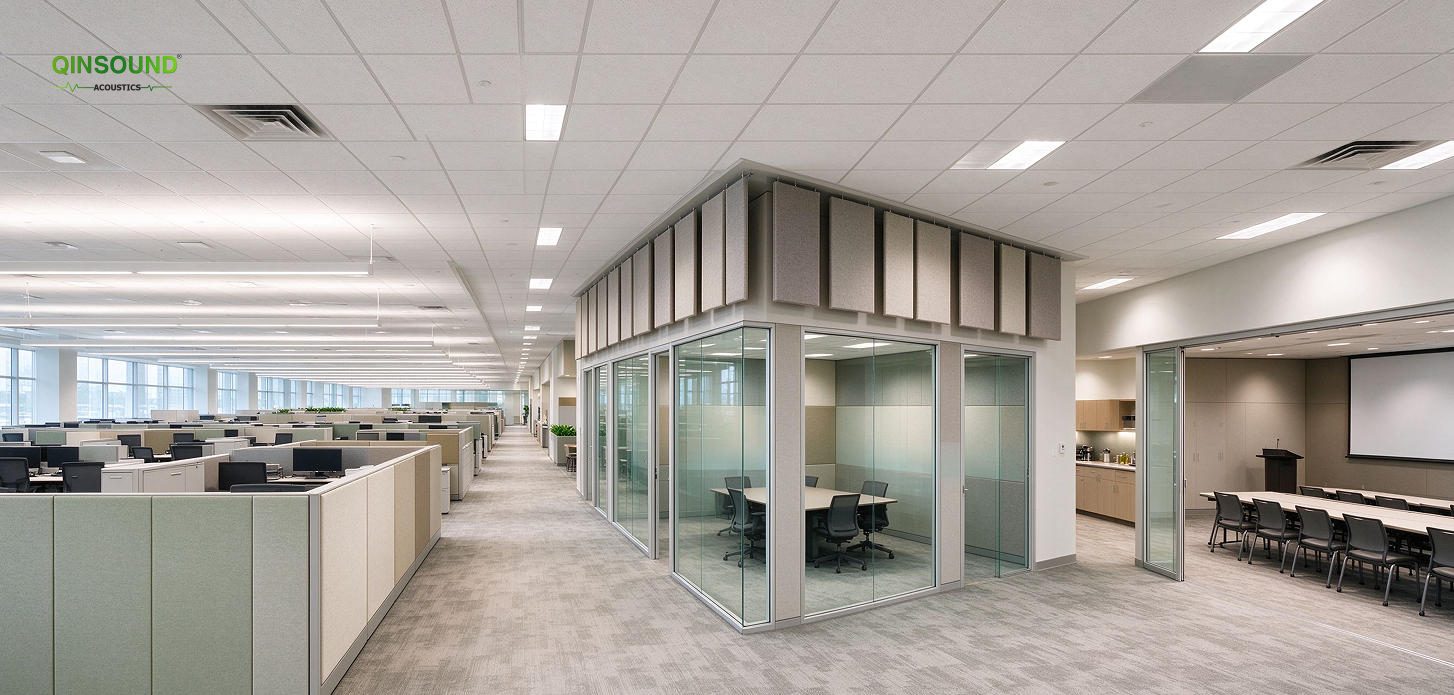
Workstation partition walls and feature walls were fitted with 100% recycled polyester acoustic panels in custom muted tones. E0 grade formaldehyde-free with impact-resistant surfaces, the panels absorb mid-high frequency speech noise while contributing to the project’s recycled material credit. Meeting rooms and collaborative zones used suspended fabric-wrapped acoustic baffles with high-density fiberglass cores, paired with ceiling absorption to reduce flutter echo and improve speech intelligibility. The acoustic design team worked alongside the sustainability consultant to document material certifications and calculate acoustic comfort metrics for LEED submission. Installation was phased by floor to align with the phased office move-in schedule.
Measurable Outcomes
- Open workspace reverberation time reduced to 0.7–0.9 seconds, meeting international premium office acoustic standards
- Cross-team speech crosstalk reduced by 39%, and meeting room speech privacy passed third-party testing
- All acoustic materials contributed to LEED IEQ and materials credits, supporting the project’s successful Gold certification
- Internal staff surveys showed a 32% reduction in self-reported acoustic fatigue
Key Takeaways
For certified green office projects, acoustic material selection must be aligned with sustainability frameworks from the earliest design stage, and acoustic performance data can directly strengthen green building certification submissions.