

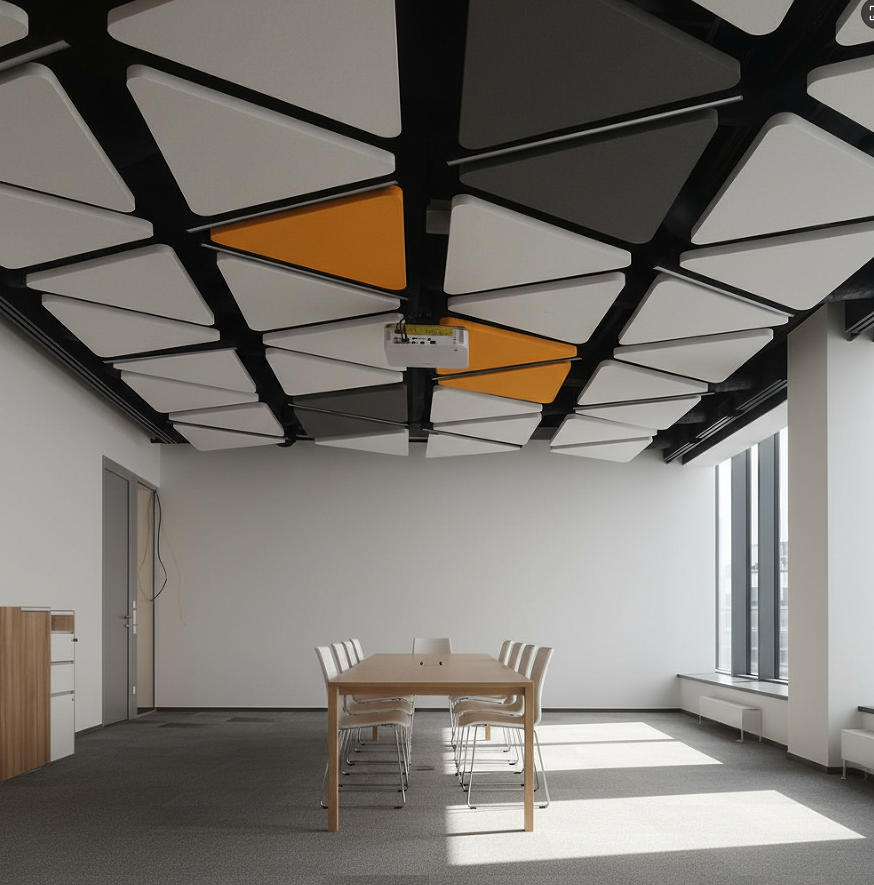
Acoustic comfort has become a core metric in contemporary commercial architecture, directly linked to occupant productivity, well‑being, and even health. According to the WELL Building Standard, excessive reverberation and background noise can reduce cognitive performance by up to 25% and increase stress‑related hormones. Modern acoustic ceiling systems address these issues through scientifically engineered materials and structures, delivering consistent, measurable performance across offices, schools, healthcare facilities, and hospitality spaces.
At the heart of any high‑performing acoustic ceiling is its Noise Reduction Coefficient (NRC), defined by ASTM C423 as the average sound absorption coefficient at 250 Hz, 500 Hz, 1000 Hz, and 2000 Hz. NRC ranges from 0 (total reflection) to 1.0 (total absorption), with premium acoustic ceilings typically achieving NRC 0.85–0.95, meaning they absorb 85–95% of incident mid‑frequency sound energy. For open‑plan offices and classrooms, the U.S. General Services Administration (GSA) recommends a minimum NRC of 0.90 to control reverberation and ensure speech intelligibility.
Beyond NRC, Ceiling Attenuation Class (CAC) measures a ceiling’s ability to block airborne sound transmission between rooms or floors. A CAC rating of 35–40 dB is considered excellent for commercial buildings, significantly reducing room‑to‑room noise transfer. High‑quality acoustic ceilings combine high NRC (absorption) with strong CAC (isolation), a dual performance that standard drywall (NRC ≈ 0.05) cannot match without additional treatments.
Modern acoustic ceilings also meet stringent global fire and environmental standards. Most commercial products achieve Class A fire rating (ASTM E84), with a Flame Spread Index ≤25 and Smoke Developed Index ≤450. In Europe, compliance with EN 13501‑1: B‑s1,d0 is common, indicating low smoke production and no flaming droplets. Many systems also contribute to LEED and WELL certifications, featuring low VOC emissions (<0.002 mg/m²/hr per ASTM D5116) and high recycled content (up to 74% in some lines).
Installation flexibility is another key advantage. Acoustic ceiling panels are lightweight (typically 2.5–4.5 kg/m²) and compatible with standard suspended grid systems, allowing easy integration with lighting, HVAC, and sprinkler systems. Demountable designs enable access to plenum spaces for maintenance without full removal.
In summary, modern acoustic ceilings are not merely decorative elements but engineered performance systems that deliver verified noise reduction, fire safety, and sustainability. For architects and contractors aiming to meet today’s strict acoustic and green building codes, selecting ceilings with NRC ≥0.85, CAC ≥35 dB, and Class A fire rating ensures long‑term comfort and compliance.