

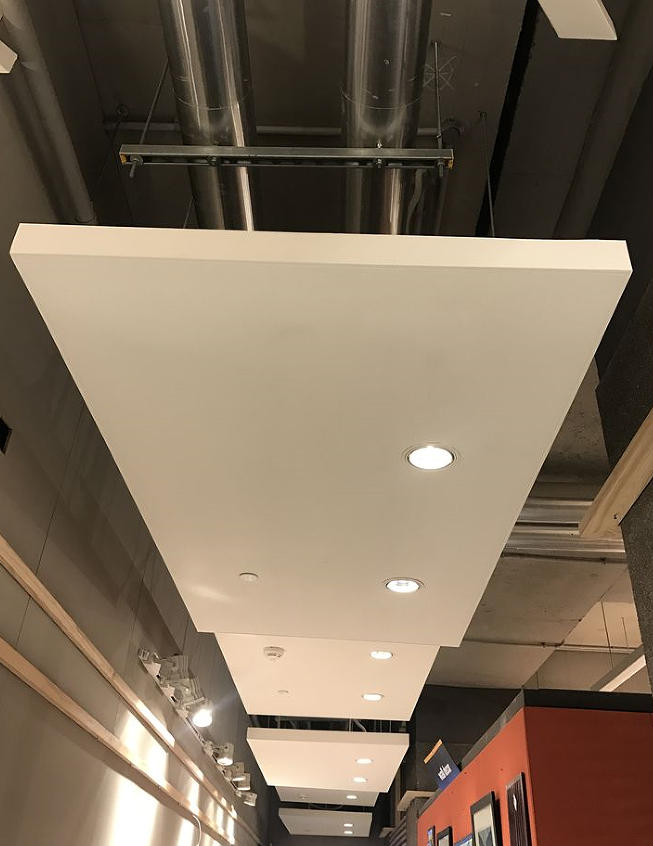
In multi‑story commercial and residential buildings, noise transmission between floors—whether airborne (speech, music, traffic) or structure‑borne (footsteps, equipment vibration)—is a persistent and costly problem. Soundproof ceilings address this challenge by combining high‑density materials, resilient channels, and acoustic absorption layers to block, isolate, and dampen noise, creating quiet, privacy‑focused environments.
The effectiveness of soundproof ceilings is measured by Sound Transmission Class (STC) and Ceiling Attenuation Class (CAC). STC ratings (per ASTM E90) quantify a ceiling’s ability to block airborne sound across 125 Hz to 4000 Hz, with higher values indicating better isolation. A soundproof ceiling with STC 50+ can reduce loud speech (80 dB) to a whisper‑level (30 dB) in adjacent spaces, while CAC 40+ minimizes room‑to‑room sound transfer through plenum areas. Standard suspended ceilings typically achieve only STC 30–35, offering minimal isolation.
A key design principle of soundproof ceilings is decoupling—separating the ceiling surface from the building structure to break vibration pathways. This is achieved using resilient channels (lightweight metal strips) mounted to joists, with drywall or acoustic panels attached to the channels, not directly to the structure. Resilient channels can improve STC ratings by 8–12 dB compared to direct mounting, significantly reducing structure‑borne noise like footsteps and HVAC vibration.
High‑density acoustic materials are critical for blocking airborne sound. Premium soundproof ceilings incorporate mass‑loaded vinyl (MLV) (density ≥3 kg/m²) or high‑density fiberglass panels (density ≥48 kg/m³) between joists, which add mass and impedance to sound waves, preventing transmission. These materials also absorb residual sound energy, reducing reverberation within the ceiling cavity.
For maximum performance, soundproof ceilings often integrate multi‑layer systems:
Resilient channel layer: Decouples ceiling from structure.
Absorption layer: 50–100 mm high‑density fiberglass (NRC 0.90+) to absorb cavity noise.
Barrier layer: MLV or gypsum board (16–25 mm) to block airborne sound.
Finishing layer: Acoustic ceiling panels (NRC 0.85+) to reduce room‑level reverberation.
Fire safety is rigorously tested, with soundproof ceiling components meeting Class A (ASTM E84) or EN 13501‑1: B‑s1,d0 ratings. This includes resilient channels (non‑combustible), fiberglass (inorganic, non‑flammable), and finishing panels (fire‑rated), ensuring the entire system complies with commercial building codes.
Moisture resistance is essential for long‑term durability, with absorption layers and barrier materials maintaining performance at 90–95% RH without mold growth or degradation. This is critical for bathrooms, kitchens, and humid coastal environments.
soundproof ceilings are engineered noise isolation systems that combine decoupling, mass, and absorption to block both airborne and structure‑borne noise. For multi‑story buildings requiring privacy and quiet, specifying systems with STC 50+, CAC 40+, and Class A fire rating ensures superior noise control and compliance.