

Project Context
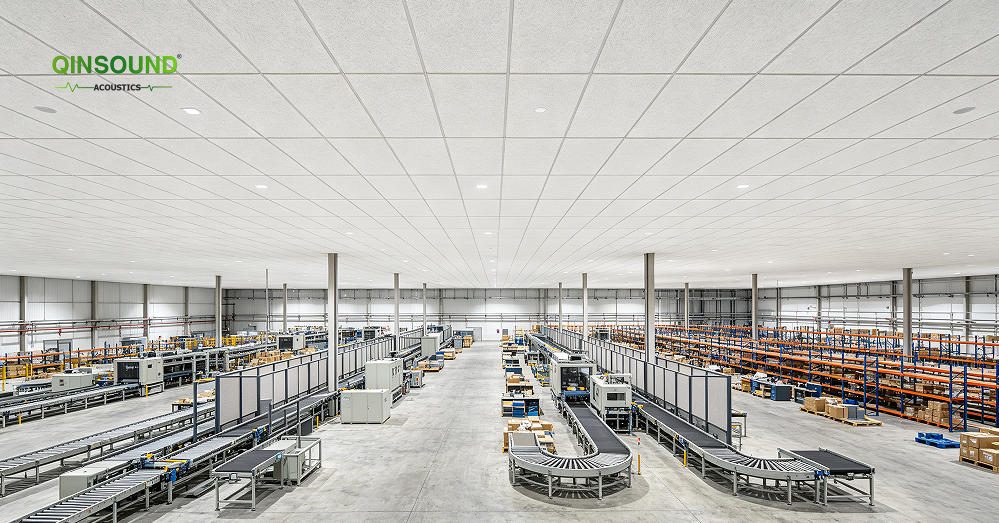
This large-scale e-commerce fulfillment center handles high-volume daily sorting, packing and shipping operations. High exposed steel roofs, concrete floors and dense automated equipment generated persistent high-level ambient noise. Conveyor belts, sorting machinery and ventilation systems produced overlapping broadband noise, exposing frontline staff to long-term noise levels above occupational health thresholds. The facility operator required a full acoustic upgrade to meet local occupational safety noise standards, with materials that deliver Class A fire resistance, moisture resistance, sag resistance and long-term low-maintenance performance suitable for industrial environments.
Custom Acoustic Solution
The project adopts a combined scheme of high-density inorganic fiberglass acoustic ceiling and damping sound barrier.
The entire sorting and packing zone ceiling was replaced with fiberglass acoustic ceiling tiles with inherent ASTM E84 Class A fire resistance, NRC 0.90–0.95, which effectively absorb ambient reflected noise from equipment and airflow. The material offers excellent mould resistance, sag resistance and dimensional stability, maintaining stable performance in high-dust, high-humidity industrial environments with minimal maintenance.
Modular sound barriers were installed around high-noise equipment areas such as conveyor transfer points and sorting machines. The multi-layer damping structure delivers up to 27 dB single-layer sound insulation, blocking direct equipment noise propagation to staff workstations.
The full 2,800 ㎡ renovation was completed in 28 days through phased night construction, with zero impact on daytime fulfillment operations. Complete test reports were provided for occupational safety compliance review.
Project Outcome
After acceptance testing, ambient noise in staff working areas dropped to within the allowable range of occupational health standards. Equipment noise propagation was effectively controlled, and on-site verbal communication clarity improved significantly. The durable low-maintenance acoustic system also reduces long-term facility operation costs. The project successfully passed local occupational safety and fire protection acceptance.