

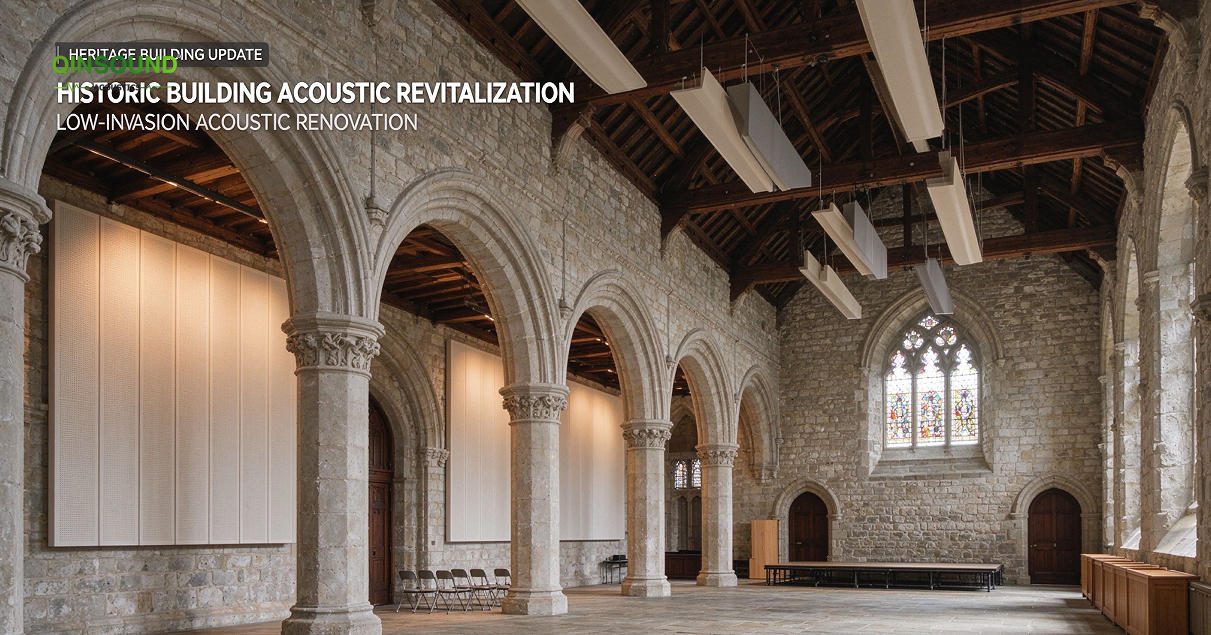
Adaptive reuse of historic and heritage buildings continues to accelerate across Europe and North America, with old town halls, churches, courthouses and industrial structures being converted into performance venues, co-working spaces, wedding venues and community hubs. Acoustic upgrade is one of the most common renovation requirements — but it must be delivered without altering historic fabric, damaging original architecture or altering protected visual features.
Heritage acoustic retrofits demand a very different approach to new-build projects. Drilling into structural walls, installing suspended ceilings or applying permanent wall finishes is often prohibited by conservation rules. Solutions must be minimally invasive, visually discreet and, where possible, fully reversible so they do not compromise the building’s historic status. Performance must still meet modern standards for speech intelligibility, music quality and occupational noise limits.
QinSound specialises in low-impact acoustic solutions for heritage and conservation buildings. Grooved perforated acoustic panels are mounted on concealed freestanding frames against internal walls, delivering tuned mid-frequency absorption without penetrating historic structural surfaces. Suspended acoustic baffles hang from existing ceiling structures to control overhead reflections, with all fixings designed to be fully reversible. All systems can be sized and finished to match the existing interior character, so they enhance acoustics without altering the building’s historic appearance.
Heritage architecture specialists note that as more historic buildings are repurposed for modern uses, non-intrusive acoustic retrofit will remain one of the fastest-growing specialist segments of the acoustics market.