

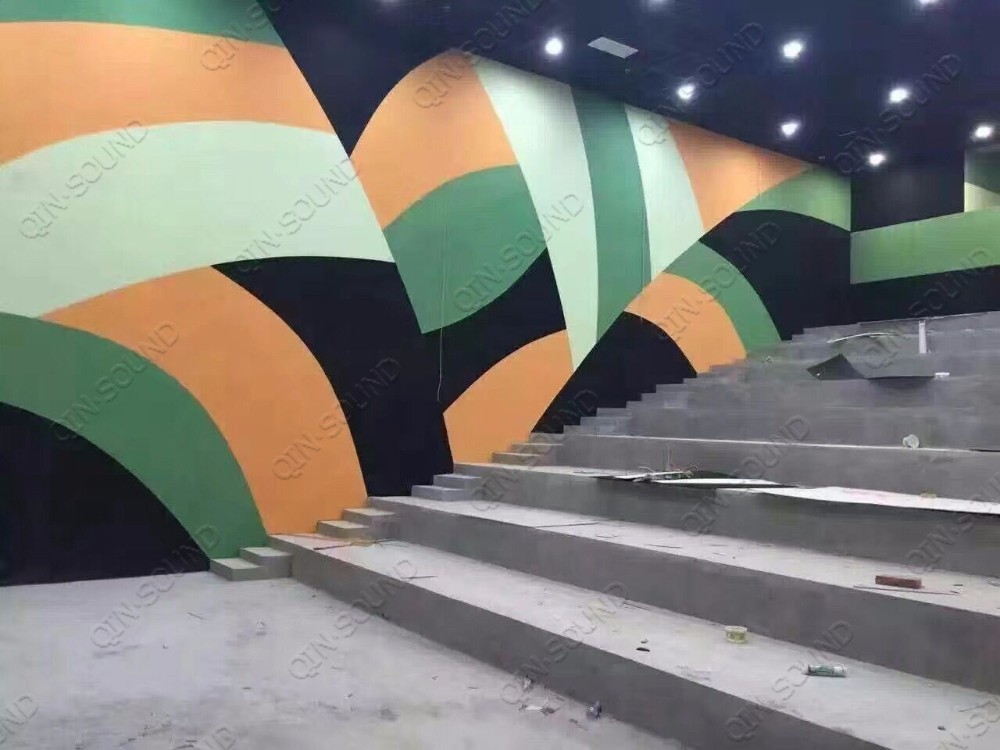
Acoustic absorption is an important means of noise control and sound quality optimization. Different from sound insulation which focuses on "blocking sound waves", the core of sound absorption is to absorb sound wave energy and reduce indoor reflection, solving problems such as excessive echo and reverberation, making the space sound clearer and softer. It is widely used in various scenarios that require sound quality.
The core principle of sound absorption is to use the porous structure of sound-absorbing materials. When sound waves contact the surface of the material, they will enter the pores inside the material. The sound wave energy rubs and collides with the material fibers in the pores, and gradually converts into weak heat energy, thereby achieving the effect of weakening sound wave reflection and reducing indoor reverberation. It should be noted that sound absorption only acts on the sound waves that have entered the space and cannot block external noise from entering, which is the most essential difference between it and sound insulation.
Common sound-absorbing materials can be divided into three categories: porous sound-absorbing materials, resonant sound-absorbing materials and film sound-absorbing materials. Porous sound-absorbing materials are the most widely used, such as glass wool, rock wool, polyester fiber sound-absorbing panels, carpets, curtains, etc. These materials are full of tiny pores inside, with good sound absorption effect and moderate cost, suitable for ordinary scenes such as homes, offices and meeting rooms; resonant sound-absorbing materials (such as perforated panels, resonant cavities) have excellent sound absorption effect for specific frequencies of sound waves, and are often used in professional acoustic places such as concert halls and theaters; film sound-absorbing materials (such as plastic films, fabrics) are mostly used for auxiliary sound absorption, suitable for alleviating low-frequency noise.
In practical applications, the choice of sound-absorbing materials should be combined with scene needs. For example, in empty meeting rooms and classrooms, due to the large space and smooth walls, echoes are likely to occur. Polyester fiber sound-absorbing panels can be laid on the walls and ceilings, matched with carpets and curtains to reduce sound wave reflection; in family living rooms and bedrooms, you can place fabric sofas, hang thick curtains, and lay carpets, which can not only achieve sound absorption effect but also take into account decorativeness; in professional recording studios and concert halls, it is necessary to match porous materials and resonant materials to accurately control the reverberation time and ensure the purity of sound quality.
Reasonable use of sound absorption technology can not only improve indoor sound quality but also alleviate the irritability caused by noise and enhance the comfort of the space. Whether it is an ordinary family or a professional place, choosing the right sound-absorbing materials and schemes according to the characteristics of the scene can create a more comfortable and high-quality acoustic environment.