

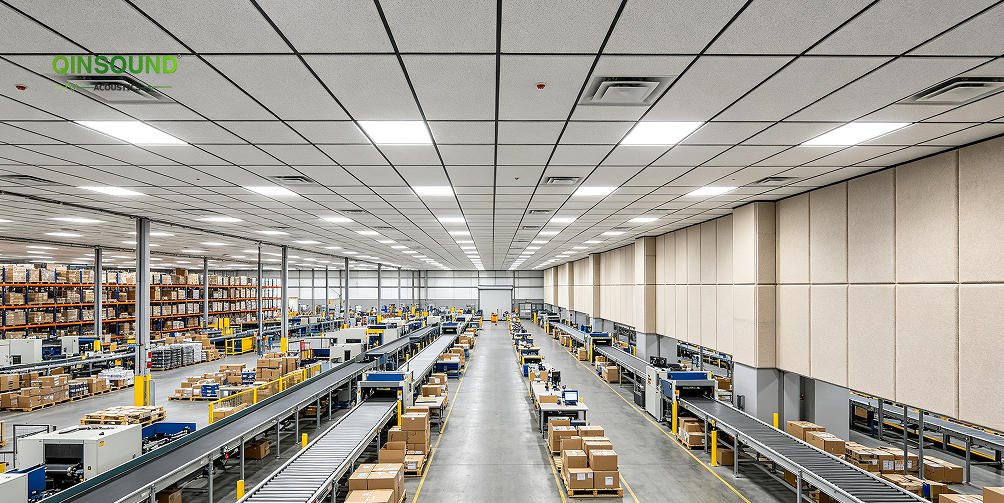
The U.S. Occupational Safety and Health Administration (OSHA) has updated enforcement standards for occupational noise exposure in logistics and warehousing facilities, lowering the acceptable long-term noise threshold for frontline workers. Against the backdrop of booming e-commerce and expanded fulfillment center construction, the regulatory tightening has driven a wave of acoustic retrofits across the warehousing and logistics sector.
Heavy-duty high-density fiberglass acoustic ceilings and impact-resistant polyester wall panels have become the core products for fulfillment center acoustic upgrades. Fiberglass ceiling systems deliver inherent Class A fire resistance and NRC 0.90–0.95 high-efficiency sound absorption, effectively reducing ambient noise from conveyor belts, sorting equipment and ventilation systems. Impact-resistant polyester wall panels are installed in high-traffic picking and packing zones to reduce reflected noise and improve on-site communication clarity. Both materials are dust-resistant, dimensionally stable and low-maintenance, adapting to the high-intensity 24/7 operation of e-commerce facilities.
Logistics real estate industry data shows that acoustic retrofit projects in the U.S. e-commerce warehousing sector grew by 34% year-on-year in the first half of 2026. Industry observers point out that as occupational health requirements continue to tighten and warehouse automation advances, industrial-grade acoustic systems will gradually shift from optional welfare investments to mandatory compliance configurations, bringing sustained growth momentum to the industrial acoustic materials track.