

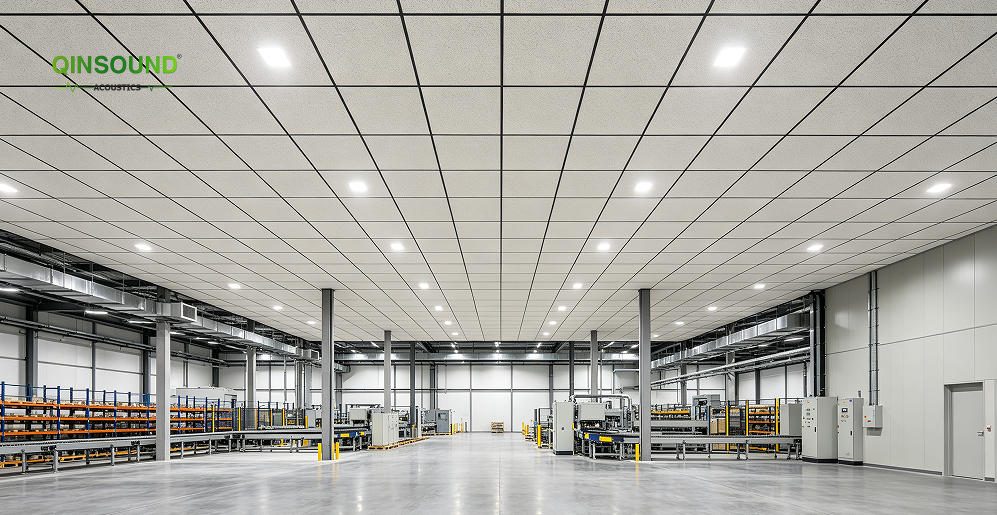
Both EU and US occupational safety authorities have updated workplace noise exposure limit standards in recent years, lowering the acceptable threshold for long-term noise exposure for workers in manufacturing, logistics warehousing, data centers and other scenarios. Regulatory tightening has forced industrial facility operators to accelerate acoustic environment upgrading, driving rapid growth in demand for industrial-grade acoustic building materials.
Heavy-duty high-density fiberglass acoustic ceilings and impact-resistant polyester wall panels have become core products for industrial acoustic retrofitting. Fiberglass ceiling systems have inherent Class A fire resistance, with NRC 0.90–0.95 high-efficiency sound absorption, which can effectively reduce ambient noise generated by conveyor belts, sorting equipment and ventilation systems. The material has excellent sag resistance, mildew resistance and dimensional stability, and can operate stably for a long time in high-dust, high-humidity and large-temperature-difference industrial environments. Impact-resistant polyester wall panels are arranged in picking and packing areas to reduce reflected noise and improve on-site communication clarity.
Relevant data shows that the scale of industrial acoustic renovation projects in Western markets increased by 33% year-on-year in the first half of the year. Industry analysts believe that with the continuous improvement of the occupational health and safety system and the advancement of warehouse automation, industrial-grade acoustic systems will gradually shift from optional employee welfare investment to mandatory compliance investment, bringing sustained growth momentum to the industrial acoustic building materials track.