


Project Overview
Acoustic treatment for the production workshop and sorting logistics area of a large intelligent manufacturing facility, with a total construction area of 6,500㎡. Dense automated production lines, conveying equipment and ventilation systems generate continuous broadband noise. Frontline workers’ long-term noise exposure exceeds local occupational health and safety standards, and on-site verbal communication is difficult. The owner requires the acoustic scheme to meet Class A fire protection standards, dust and moisture resistance, impact resistance, and adapt to long-term operation in industrial environments.
Solution Deployment
The solution designs a two-dimensional comprehensive control system of "top absorption + side barrier":
- Full workshop ceiling: Fitted with high-density inorganic fiberglass acoustic ceiling tiles, NRC 0.90–0.95, inherent Class A fire resistance, excellent sag resistance, dust resistance and dimensional stability. It effectively absorbs ambient reflected noise from equipment and airflow, maintaining stable performance in high-dust, large temperature difference industrial environments.
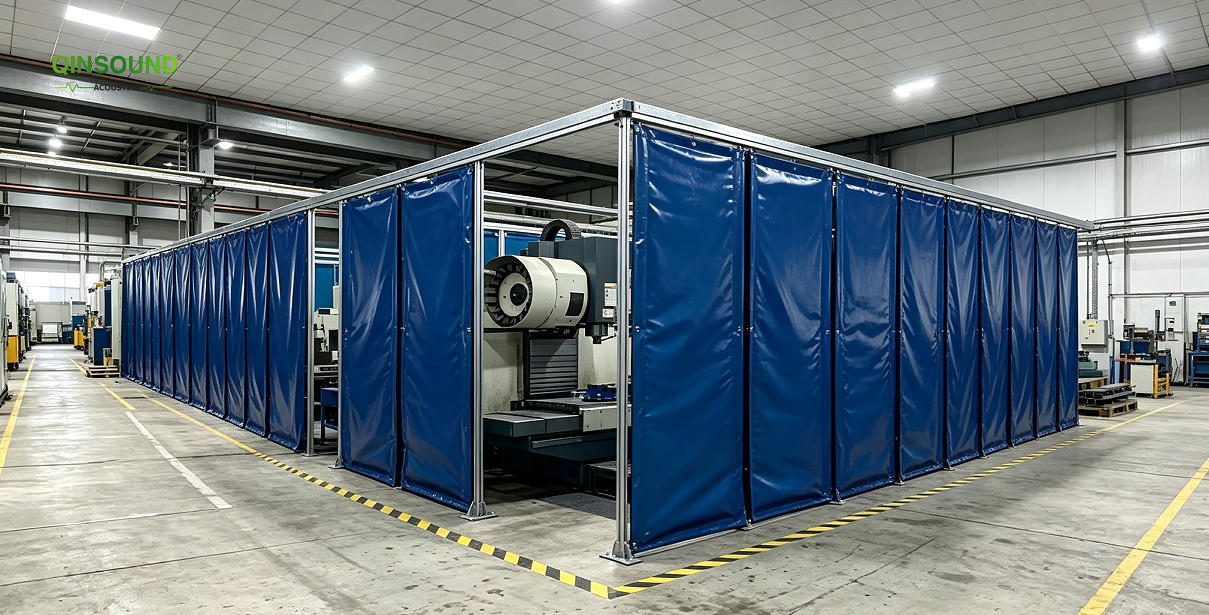
- High-noise equipment perimeters: Installed with modular damping sound barriers, with a single-layer STC rating of up to 27dB. The multi-layer damping structure blocks direct propagation of equipment noise to staff workstations. The modular design supports repositioning and adjustment with production line layout changes, and the surface is impact-resistant and easy to clean.
- Equipment rooms & partition walls: Added perforated acoustic panels with mineral wool backing to further assist with mid-low frequency noise control.
All materials meet ASTM E84 Class A fire safety standards. The project is constructed in phases during non-production hours, with a construction period of 36 days, with zero impact on normal production and delivery.
Project Outcome
Acceptance testing confirms ambient noise in staff working areas falls within the allowable range of local occupational health standards, on-site verbal communication clarity is significantly improved, and plant boundary noise meets environmental emission standards. The durable, low-maintenance acoustic system reduces long-term operational risk for the enterprise, and successfully passes occupational health and fire protection assessments.