

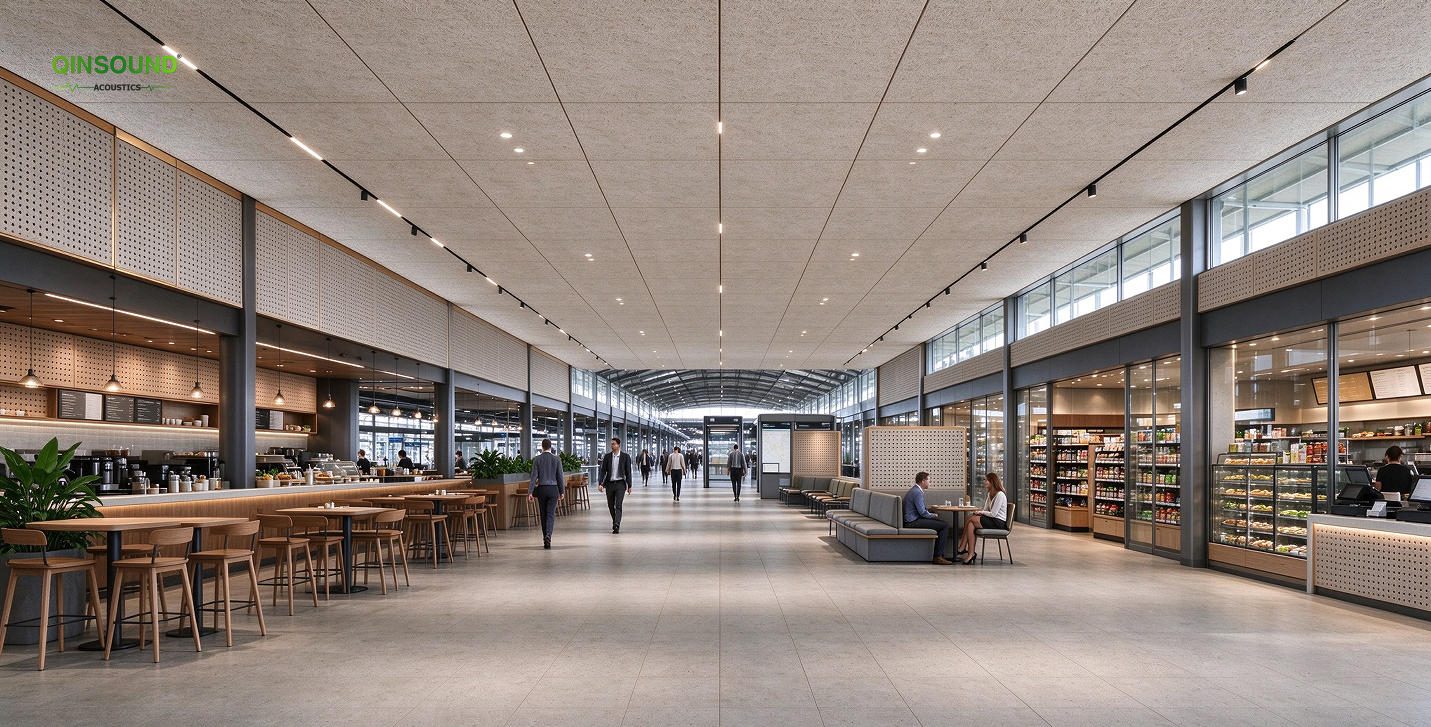
Project Background
This 5,100 ㎡ transit-oriented retail and leisure complex is connected to a major suburban railway station in Brisbane, housing cafés, casual dining, convenience retail and community waiting areas. High footfall from commuters, combined with hard tile floors and glass facades, created a loud, reverberant environment that reduced tenant sales performance and passenger comfort. The brief required durable, easy-to-maintain acoustic materials suitable for high-traffic public use, compliant with Australian public building fire standards.
Core Acoustic Challenges
- Long reverberation and high background noise across large open circulation and dining zones
- Materials had to be impact-resistant, easy to clean and capable of withstanding heavy daily footfall
- All acoustic products needed full AS/NZS fire certification for public assembly buildings
Solution & Implementation
Main circulation, dining and waiting zones received cement wood wool acoustic ceiling panels as the primary absorption treatment. The dense cement-bonded surface is scratch-resistant, easy to wipe clean and performs well in high-traffic public spaces, delivering NRC 0.80–0.90 broadband absorption. Feature wall sections and seating nooks used perforated acoustic wall panels with mineral wool backing to add targeted mid-frequency absorption and reduce sound reflections off hard wall surfaces. Installation was scheduled outside peak commuter hours to minimize disruption to station operations. All materials were supplied with full Australian fire certification documentation to support the building approval process.
Measurable Outcomes
- Peak-hour ambient noise across the complex reduced by 36%, improving passenger comfort and retail atmosphere
- Reverberation time in dining zones dropped from 2.3 seconds to 1.1–1.3 seconds
- Tenant feedback surveys showed a 31% improvement in customer dwell time ratings
- All materials passed local public building fire and safety acceptance
Key Takeaways
For high-traffic transit retail spaces, durability and cleanability are just as important as raw acoustic performance, and ceiling-based absorption is often the most practical and low-maintenance primary treatment strategy.